Presentation
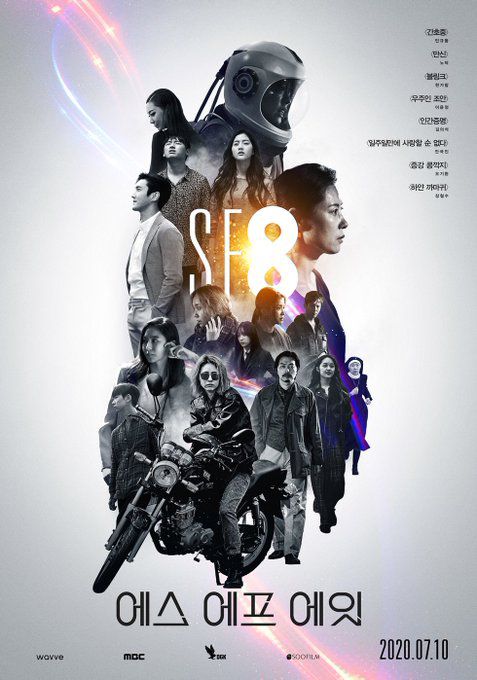
Korean Title: SF8
Aired in: 2020 (8 independent episodes)
Channel: MBC
Grade: 10/10
Analysis
SF8: Episode 1 – The Prayer
Synopsis
Gan Ho Jong is a robot nurse. She has to take care of Yeon Jung In’s sick mother, who’s been unconscious for 7 years. Seeing that Jung In is on the verge of committing suicide, the robot takes makes a radical decision, putting an end to Jung In’s mother’s life. In the process, she ends up conversing with a nun, sister Sabina, trying to convince her not to do the unforgivable.
What are the themes questioned? (Spoiler Alert)
SF8’s first episode really got me interested in and intrigue during its whole 53 minutes! I was really impressed to see how they managed to combine several serious themes in such a short amount of time, without making the episode too heavy to watch.
Robotics and criticism: The first theme that is more than evident is that of robotics. In a futuristic, almost apocalyptical world, in which many people get sick, humans had to technologically adapt their offer to the demand. Therefore, they created a whole range of robots, working as replacements of actual nurses. This would represent a constant care for the patients and lessen at the same time guardian’s burden. To do so, a German robotic firm launched several series of robot nurses, upgraded at each new generation. I really thought it made sense that they would choose Germany as the robots’ manufacturing country, especially when we consider the technological prowess Germany is already capable of. I actually also wondered why they wouldn’t choose Japan instead, considering Japanese capabilities in that field. After doing some thinking, I actually see two explanations: first, it would be too controversial to present Japan as this almost world domineering country in that field considering the tense relationship between the two countries. Second, I believe it also has something to do with the underlying criticism of the Korean health system.
Indeed, in that episode, only the rich can afford upgraded version of the robot, able to take care of both patient and guardian. On the other side, those unable to afford such a technology, are forced to spend all their savings, time and energy in their family member’s care. The side story involving the woman taking care of her crazy husband is the best epitome of that dark situation. She can’t pay a robot, and even when she does, she has a reconditioned one, that eventually lets her die, when she commits suicide. In that matter, the criticism of the dramatic health system is South Korea is pretty clear, in my opinion, exposing that money-driven system, that focuses on profit rather than treatment. By the way, it is a criticism that you will find very often in dramas, as a reflection of Korean society.
Can robots feel? In all science fiction programs, involving robots, the problematic of whether robots are able to feel or notis quite frequent, if not mandatory to tackle. The first episode of SF8 thus questioned that problematic as well. The situation is not as complex as it seems: the robot has to choose between an unconscious woman creating pain and a living one on the brink of killing herself? I really believe that dilemma is close to that of the tramway (for instance: would you rather save one old person or a group of adults?). In that matter, the robot, that got to know Yeon Jung In (Lee Yoo Young) better, decides in her favor. It “felt” her pain and need to be rescued, which blew up her system, as one of the scene confirms it. The robot ends up being thrown away by Jung In, who resents it for killing her mother. Yet, I could see how beneficial it actually was for Jung In to be free of her mother. She got rid of a long-lasting pain, she was not able to overcome, while her mother was still alive.
If we peel another layer of that episode, I even found that some scenes raised the question of euthanasia and homosexuality. Euthanasia on the one hand because of Ho Joong’s action, killing a living human being in order to relieve everyone from their pain. Homosexuality on the other hand, because of that one peculiar scene between Jung In and Ho Joong at the morgue. The episode didn’t go deeper in terms of allusion, but I could clearly see some references.
Religion: Finally, connected to all these themes, is the overall topic of religion that runs through the entire episode. Sister Sabina (Ye Soo Jung) and Ho Joong’s phone calls were pretty much like a discussion in a confessional that could’ve started with the sentence: “Forgive me sister, for I have sinned? I killed someone”. These conversations also question the role of religion and its power in people’s healing and treatment, or should I say its lack of power? Even Choi Jung Gil (Yum Hye Ran), who takes care of her crazy husband, resorts to praying as her only salvation. The drama is also cut into two distinct part, one that can associate with Paradise and the other one with Hell, when sister Sabina goes to Germany to see the discarded robot.
At the end, I really felt sister Sabina and Ho Joong were in the fiery pit, Ho Joong being punished for her murder and sister Sabina, witnessing that scene and tempted by the devil to do the same. The last words are a clear reference to the biblical story of Cain and Abel. For those who don’t know it: Cain and Abel were twin brothers (like Ho Joong and Jung In, right?). One day, God is being given a choice between Cain’s offering and Abel’s. God chooses Abel’s. In pain, full of resentment and jealousy, Cain kills Abel, becoming the first murderer ever.
On the basis of that story, I see two possible explanations of the episode. First, Ho Joong is Cain and kills Jung In’s mother, becoming the first robotic murderer ever. Thus, it is being send back to the HQ and kept in a warehouse, condemned to suffering and pain for eternity. Second option, Ho Joong is Abel and Jung In is Cain. Jung In destroyed Ho Joong and threw her in eternal pain, by betraying her and killing it. Which would explain Ho Joong’s and the robots’ revolt at the end. I personally believe the first option is the right one, but as I ended up with 2 interpretations, I shared both my views.
“Am I my brother’s guardian?” While were are on the biblical reference, that sentence is clearly mystical. This is the sentence Cain said to God after killing Abel. The term guardian here is to be linked with the Korean title Ganhojoong and the name of the robot. It means caregiver and to an extend the guardian of a patient, the one taking care of the sick. This sentence applies to both Ho Joong and Jung In: Ho Joong took care of Jung In’s pain by killing her mother and Jung In got rid of Ho Joong for not properly caring for her mother. Who is whom guardian?
I let you give me your theories on that episode!
SF8: Episode 2 – Manxin
Synopsis
7 years ago, a company called Precon developed an app capable of predicting its users’ future with a 96.3% accuracy rate. Convinced that this app is the reason why her sister has died, To Sun Ho tries to find the developer of the app. In her quest, she is helped by Jung Ga Ram, who for personal reasons, wishes to find the developer as well.
What are the themes questioned? (Spoiler Alert)
Predicting the future, not living the present: This episode of SF8 revolves around the almost omnipotent existence of an app that is able to tell people with a 96.3% rate what their tomorrow will be like. This drove populations to a sort of frenzy, in which they anxiously wait for their daily prediction at midnight and fear the rest of the day. I think the underlying criticism of our societies today is pretty clear. We all now live in a world, that is first driven by technologies and second, turned toward the future and even to a point that we have the perverse need to know our tomorrow. As human beings, it is understandable that we think about the future, because as the saying goes “you never know what tomorrow will be like”. Moreover, as beings, we fear what we can’t know. We are anxiously waiting for answers and trying to find some in all possible fields, going from our future week at work to the mysteries of the universe. On that matter, there is no problem in trying to plan as much as you can. Yet, Manxin is more a reflection regarding the limitation of that doing rather than a pure observation of how we try to prepare. Indeed, the real questions are: up to what point do you let someone or something dictate your future? When do you stop worrying for the future and start living in the present? Because in reality, present is what we all have abundantly without worries. Present, is the only time in our live over which we can have control. The capacity given by Manxin to take control over their lives and assert a certain power turns more into a curse than a blessing. For example, To Sun Ho’s (Lee Yeon Hee) sister started living according to the app, following its every indication. She eventually died, yet we discover that she died, while trying to overcome her addiction. She certainly in some ways took control over her own life by getting rid of the map, even if it means she lost the possibility to foresee her future.
I believe Manxin really managed to tackle that philosophical debate and to shed light on the “Carpe Diem” saying that kind of got lost in translation in our modern societies. The episode exacerbated the need for people to sometimes learn to let go and give up on things they are not supposed to play with, like destiny and fate.
Finally, don’t you think it matches South Korea’s mania and love for fortune tellers?
Dangers of technology: This episode also exposes the dangers of technology in general. Indeed, the appearance of Manxin on the market turned everyone crazy, so much that they didn’t even know how to live on their own. It also divided the population into two major sides: those for and those against that kind of technology. Of course, the drama manages to show pretty clearly these two sides (within each the drawbacks and the advantages), embodied each by a character. On the one side, To Sun Ho is against that technology. She refuses to use the app, even to install it, because she doesn’t want to let anyone tell her how to live. Adding another potential fear is the fact that her sister could’ve died because of that app, reinforcing her rejection towards it. On the other side stands Jung Ga Ram (Lee Dong Hwi) a true believer in the cause. In his opinion, Manxin was able to save countless lives because of its true predictions. Indeed, if you know that you can have an accident by going out today, you simply can stay inside and avoid the problem. Once again, that character just like Sun Ho, is biased by his subjective experience with Manxin. When he was about to commit suicide, the app told him hardship was over for him. Since then, he hasn’t stopped believing it.
When Manxin is supposed to be reset and updated, these two sides clash and collide. In the end, the AI (that is at the origin of the app) decides to distribute odds evenly. Instead of a 96% accuracy rate, it goes down to 50%, giving to human beings a chance to forge their own future and avoiding as well to play The Almighty. It is interesting to see how the drama manages to give some humanity to the AI that longs for a human existence. Indeed, after observing them for months and months, it wants to be like it and live in the unknown. It refuses its omnipotence. Therefore, it decides to provide people with a 50% of accuracy. This also enable to satisfy quite everyone in the end.
This episode clearly highlighted the importance to think about all potential aspects of a technology, when creating one. Even if it’s not possible to predict it all (just like the app proves it), developers should at least try to figure out the downfalls and great problematics induced by their creation.
To that point, I am even wondering who played God in the drama: is it really the AI by giving out predictions with such accuracy? Or is it the developers who created the AI capable to do that in the first place?
Cult: Speaking of God, I clearly think that Manxin draws also attention to the derives of believing in such messiahs, that happen to take a variety of different forms today (humane or technological that is). When To Sun Ho is desperately trying to find the developer of the app, she stumbles upon what seems to be a cult, worshiping and adoring the AI for its predictions. Just like Jesus was God’s messenger and showed believers the way, the AI could also be seen as God’s messenger, protecting them from future misfortunes. Manxin shows also how easily people fall for these tricks and how prompt they are to believe someone has come to rescue them. Plus, the name Manxin is, to me, a clear reference to God; Sin meaning God in Korean. On the other side, Man represents men.
In overall, that second episode of SF8 was very well done, with beautiful scenes and cinematographic pictures (reflection in Sun Ho’s glasses for instance). The ambiance was sometimes mysterious and considering the difficulty to tell the story, I really think it was crystal clear in terms of understanding.
P.S.: Lee Dong Hwi and Lee Yeon Hee are excellent!
SF8: Episode 3 – Joan’s Galaxy
Synopsis
In 2046, people are separated between two sides: the Cs (Clean) who managed to have vaccine against the toxic fine dust from outside and the Ns (Non-Clean) who didn’t and thus a short life expectancy (30 years). Io thought she had the vaccine but discovers that it was mistakenly given to someone else. Therefore, she tries to find out who that person is in order to see how she lives. In her search, she is helped by Joan, a N who lives her life freely.
What are the themes questioned? (Spoiler Alert)
Ecological and social disaster: Joan’s Galaxy puts forward the danger of not taking care of the environment properly. It highlights an ecological disaster, producing toxic fine dust and threatening people’s existence. The future is not that far away, since the action takes place in 2046; which strengthens the fact that we, as a society, need to think about our planet right now, if we wish to avoid this terrible situation in a nearer future. The episode offers a great reflection on ecology and raises awareness on the environmental issues, but goes even further by revealing the inherent social consequences that such a global catastrophe would induce. Indeed, having the population separated between Ns and Cs, is just a reliable depiction of the even greater discrepancy that such an issue would produce. On the one side, you have the Cs, favored from birth and able to live up to 100 years old. On the other side, you have the poor side, unable to afford a vaccine and obliged by society to have a shortened life expectancy. Moreover, the episode insists on the difference in terms of mindset that the fine dust created. The Cs consider the Ns as dirty, unclean and are not willing to mix with them.
Considering South Korea and the world today, that episode is criticizing the potential lack of awareness but mostly of action in the face of global warming, as well as the discriminating health system, advantaging those who can pay over those who can’t. Just like in the previous episodes, SF8 has insisting a lot on the problems regarding the health system in South Korea and the need to bring some changes to it, so that poorer people can also be treated.
What do you need to be happy? Apart from pointing out the negative consequences of the world characters live in (and we live in), the episode offers a philosophical reflection as well. Indeed, the Cs live longer than the Ns, but their condition turn them into fearful people, spending their entire 100 years of existence suppressing their desires and dreams because of their fear of being contaminated. Hence, they go outside wearing astronaut suits, they can’t go everywhere they want and can’t do what they wish. On the contrary, the Ns are free and actually pursue their dreams. Because they know that they will eventually die soon, they refuse to procrastinate and have no time to realize their dreams later. That’s why, they tend to be more passionate. They live their life to the fullest, have no time for regret or doubt, because they are aware that there may not be a tomorrow. For instance, Joan’s sister is a wonderful and notorious pianist, Joan wants to work at the observatory even though she may not be able to do it for long. They are still motivated and driven to move forward. I really thought that the episode emphasized clearly the nowadays issues concerning people’s mindset. Indeed, what is a life full of worries and fear, in which you suppress your desires so that you would live longer compared to a life, in which you’re free and confident that you can do everything that you want? Isn’t it in reality better to live your life for what it is rather than enduring it? It is in fact a question of happiness, where to find it and how to find it. You should decide for yourself what brings you joy in life, instead of carrying the weight of being alive without enjoying.
In the episode, Io actually gets to discover this other side of life, as she hangs out more and more with Joan. She has a taste of happiness and discovers another side of it. Her past and her being pampered by her mother, collides with the ugly truth of her not being vaccinated. Still, instead of imprisoning her and carrying this life sentence, she becomes free. Free of living life the way she intends to live it. What about you? What would you do if were in Io’s place? Live free and happy or live in sorrow and sadness?
Stars and universe: The title of the episode “Joan’s Galaxy” gives away an important part of the story focusing on the stars, the cosmos and the universe. The actual Korean title means “Astronaut Joan”; a clear reference to the astronaut suit that Joan and Io wear to protect themselves from the fine dust. Moreover, Io, as indicated in the episode, is the name of one of Jupiter’s moon, linking directly the character to the stars. Interestingly, there is an entire mysticism around the relationship connecting both Joan and Io. More than just becoming friends, their bond transcends cosmos itself, through the metaphorical sentence: “I can see the stars”, pronounced as they touch each other for the first time. Personally, I liked to see how their friendship goes beyond social classes and personality differences. They are connected thanks to their love for the sky (Joan and Io applied to become astronauts at the observatory) and their interest for the moon. I couldn’t tell whether Joan, wanting to be an astronaut, was the one studying the strange behavior of Io (Jupiter’s moon) trying to get closer to her; or if Io was actually bringing the cosmos towards Joan and giving her a shot at life.
Looking for the man who got the injection: Technically, Io and Joan become friends because of a mistake from the past, meaning that Io’s vaccine was actually given to a man, or so it seems. In order to understand how that person is now living, Io looks for him, hence meeting Joan. As the episode moves forward, it seems that the man who got the vaccine died as a firefighter, while trying to rescue people. At that moment, it appears like his chance at life was actually given away for nothing. Moreover, Io is gravely sick and has to undergo surgery, if she wishes to expand her life expectancy. She is not willing to do so, especially because she has learned she can live happily even for a short time, without restricting or restraining herself (what the surgery would force her to do). When we finally believe that Io will die and Joan as well; the twist occurs. In reality, Joan was the one who received the vaccine in Io’s place. However, Io didn’t say anything because she understood that Joan’s passion for life was coming from the fact that she would die soon; forcing her to achieve her goals as fast as possible. Her passion is also her driving force and proves that she can become of one the best astronauts there is. Indeed, she joins the observatory and turns into a promising intern. The episode ends with a bittersweet taste. Even though Io survived the operation and Joan can live her dream, their connection has been severed for more than a year. That being done in order to protect the secret regarding Joan’s life condition. From Joan’s perspective, Io was her life savior. However, from Io’s perspective, her life savior was Joan. She is the one who gave her the will to live. That’s why keeping the secret is a sort of final giftto Joan for saving her.
Dealing with death: Apart from tackling those issues, the episode also demonstrates the different ways to cope with death. The Ns die very young, they lose their family members pretty soon and are rapidly confronted with them. Therefore, they have different methods in order to accept death as part of the existence. The reflection goes even further, when that kind of mindset crashes with that of the Cs; who are unable to overcome their fear of dying every day. Io’s shift in condition is also an eye-opener for her, since her situation makes her think about the best way to eventually say goodbye or accept her sickness.
SF8: Episode 4 – Blink
Synopsis
Kim Ji Woo is a detective who has artificial eyes, that help her being a better cop. She had a car accident as a child, which made her distrust AI, so she has problems adapting with her new technology taking the form of a man called Seo Nang.
What are the themes questioned? (Spoiler Alert)
Dangers of AI: Like many episodes from that series, Blink emphasizes the dangers that AI can represent when used in daily life. Indeed, Kim Ji Woo uses augmented reality eyes in order to get access to files more rapidly and to arrest criminals more easily. Even though, this process seems to be very useful and positive, some threats enter her life when her AI eyes become even more upgraded. First danger that I spotted was the fact that the police actually hacked into her AI eyes and upgraded them without her consent. This is a clear derivate of what could potentially happen in a very near future if these technologies are not regulated enough. Moreover, there is a passage in the episode focusing on young adults administrating themselves drugs in a whole new way; shedding light on another danger of AI. As technology evolves, so do dangers. Of course, because of her new eyes, Ji Woo is being chased by a police officer who used to be part of the experience. However, the AI turned against him and transformed him into a killer, destroying all other AI.
I believe that Blink perfectly exposed the advantages of using AI (arresting criminals, easier life…), while putting forward the evident dangers it implies. People fighting over technologies; AI taking the upper hand over the body and the mind; and even ruining one’s life. This episode is a way to raise awareness regarding those eventual issues and to call for a real regulation of those new technologies, developing at light’s speed.
Trusting an AI: Ji Woo is a solitary character, traumatized by a car accident that took the life of both her parents. Indeed, she was in a self-driving car, whose system was designed to protect her first; causing therefore the death of her parents on the spot the day of the accident. In a blink of an eye, she became an orphan and distrusted any kind of AI. That’s why, she is not very pleased when she is installed an AI called Seo Nang, that only she can see. Despite its incredible capacity to hack into systems and find relevant information, Ji Woo can’t adapt to Seo Nang, because she fears her past will repeat itself. Yet, Seo Nang proves that AI are also capable of doing good things. Indeed, it manages to enter the other killer’s system and destroy it. In the end, SeoNang’s presence was pretty therapeutic for Ji Woo, who finally opened up and partnered up with an AI.
I loved the fact that the episode is not constructed around criticism or judgement regarding AI. On the contrary, it wishes to show the bad and the good sides of using AI, with the goal to warn people and ask them to be careful.
Video games: It is clear that this episode was less complex than the previous ones in terms of reflective themes. This doesn’t mean that is was not astonishing on its own! Indeed, It really felt as if I was in a video game, if not in Matrix, when I witnessed the incredibly well-done action and fighting scenes. It was some of the best scenes I have ever seen! The simulation of a ring, the numerous fights, the entire episode was designed to make viewers feel as if they were playing a video game in augmented/virtual reality.
SF8: Episode 5 – Baby it’s Over Outside
Synopsis
Kim Nam Woo has just become a police officer after 4 years of struggle. Unfortunately, a meteorite is expected to crash on planet Earth in a few days. Since the world is coming to an end, a number of super humans reveal their existence and try to stop the meteorite. Nam Woo meets Hye Hwa, a super human, who is looking for a way to stop this disaster.
What are the themes questioned? (Spoiler Alert)
The gap in reaction: The first minutes of the episode are quite alarmist, showing that a meteorite is going to destroy the planet. A countdown has been set so that people can know when the end approaches. Considering that the face of the Earth is going to be wiped out, I was expecting chaos and crazy behaviors from the population. Yet, there is a clear discrepancy between the expected overall reaction and the actual one. Indeed, instead of fighting each other, human beings prefer uniting, confessing their love to the other before it is too late and enjoying life to its fullest. Joy takes over panic.
People with superpowers: As if people’s reaction was not unexpected enough, a number of super humans emerge and try to unite in order to prevent the Earth from disappearing. I really loved the fact that the tone of the episode was absolutely not in correlation with the gravity of the story. Indeed, we expect these super humans to become sorts of Avengers, capable of destroying the flying rock; but instead their powers are almost laughable and irrelevant. One can for example create a flame (a little one) in his hand but nothing more; another one can change water into something else… The scale of the powers revealed is very low and appears quite ridiculous compared to the meteorite coming down on Earth. Even the main characters’ powers seem stupid. Hye Hwa can make sure that everyone who loves her never forgets her (that was the case when her mother had Alzheimer’s) and Nam Woo discovers that he can’t die from unnatural death. So every time that he dies because of an accident, his life goes 4 years backward. Therefore, he has no memory whatsoever from before.
Unexpected turn of events: After discovering that their powers might actually save the world – Nam Woo can go 4 years in the past and can tell everyone about the meteorite before it is too late thanks to Hye Hwa he couldn’t forget – the ending takes an unexpected turn when Hye Hwa refuses, at the last minute, to fall in love with Nam Woo, saying: “I can’t”. Once again, that scene emphasized the gap between the serious tone and the humoristic one.
The ending: Even though we go back to normal, 4 years in the past and that Nam Woo and Hye Hwa seem to be complete strangers; it seems like there is hope at the end that Nam Woo might remember something as he turns towards Hye Hwa, who happens to live in the same goshiwon. Will it work this time?
The direction: I couldn’t talk about that episode without mentioning the incredible direction. The colors of the burning sky were simply amazing and incredibly beautiful. In my eyes, it looked like a painting and really gave an “end-of-the-world” vibe. I loved it! The Korean title and its English translation are also very interesting. Indeed, the Korean title “Can’t love in a week” shows that even if it is the end of the world, you can’t force love and feelings. It opens up a certain reflection on that matter; demonstrating that loving someone is something you have to feel and not think. Moreover, it is not something you can force yourself to do if you don’t want it. From that perspective, maybe the world is definitely supposed to come to an end. Or maybe, our main leads may fall in love 4 years in the past? The ending is actually quite open to interpretation.
The English translation stresses the fact that the world is ending saying “Baby it’s over outside”, a great reference to the song “Baby it’s cold outside”. Either it’d be the Korean or the English title, they are both quite explicit and well-chosen in my opinion.
SF8: Episode 6 – White Crow
Synopsis
Juno is a video game streamer, who is accused of lying about her past by an online comment. This crushes her reputation. In order to prove she didn’t lie, she decides to partake in an experience called IOM2. In this virtual reality game, the player has to overcome his/her trauma to get out and wake up.
What are the themes questioned? (Spoiler Alert)
Greek Mythology and lies: Mythology holds a great place in this episode, that chooses to tackle new themes, either social, societal or technological, that were left untouched by previous stories. There are two main elements that embody the heart of the plot in this episode, as the title indicates “White Crow”.
The crows: Hence, the first element that needs to be discussed is the crow. The episode is focusing its plot around lies, using the very old story of Apollo and Coronis from the Greek mythology. In the story the dark crow is a symbol of lies, while the white one is that of truth and innocence. To sum it up, here is the myth: “In the Greek mythology, Apollo used to use white crows as his messengers. Because he had fallen in love with Princess Coronis, the God sent his white crows to watch over her. One day, one of them delivered his message late. Apollo asked why it was late and the crow answered that it was because Coronis had an affair, which was a lie. Apollo believe the crow and killed Coronis. Later on, he found out that the crow had lied to him. Out of anger, Apollo burned the crow to death, turning his wings black”. The black crow is of course a metaphor of Baek Ah Young/Juno’s lies and the game emphasizes this figure in order to force her to admit them.
The names: Not only the metaphorical mention, but also the name of the characters holds meaning. Indeed, Juno is the Roman name of Hera, goddess of the Gods, Jupiter’s wife and supreme sovereign. In the mythology, she is an extremely jealous woman, willing to destroy all of her husband’s conquests. In that matter, Juno’s name is an excellent reference to her personality. Indeed, at some point, Baek Ah Young (Juno) got jealous of the real Jun Oh’s life (her wealth, parents…) and decided to turn her back on her, pushing her into committing suicide.
Considering all of these elements, it is clear that the virtual reality is symbolic and therapeutic at the same time; but it can also bring confusion to the player: here Juno’s real identity.
Personality disorder: The confusion comes from the fact that Juno has convinced herself she is the real Juno. However, her real name is Baek Ah Young, who used to be Juno’s friend but betrayed her. This led to Jun Oh’s suicide, who considered Ah Young her one and only friend. After her friend’s suicide, Juno developed a personality disorder, replacing her identity with that of Jun Oh. Hence, the comments at the beginning of the episode telling her she had died. By the way, the episode is really shedding light on the terrible consequences of haters commenting online. Their negative influence on celebrities’ minds has been proven many times and the episode was a good reminder of it; forcing us to acknowledge the issue it represents (Please don’t leave hateful comments to anyone, it may mean nothing to you, but it can literally destroy the other person!).
School bullying: White Crow also demonstrated the violence of school bullying, raising awareness regarding that plague. The episode perfectly managed to incorporate it to its plot, while delivering a certain warning and sense of urgency. Jun Oh and Ah Young were outcasts, hated by the entire school and this led to dire consequences: one dying, the other one betraying her friend to fit in. South Korea has been many times criticized for its terrible school life and that episode is another example of this criticism.
Derives of virtual reality: Of course, this episode of SF8 wouldn’t be complete without a focus on the technological derives. Here, it tackles a new device (virtual reality) that is supposed to heal people from their traumatic past. Once again, even though the idea seems interesting and helpful, it ends up as a catastrophe. Indeed, the systems overheat and indirectly kill Juno. Indeed, she was stuck in the game, not able to go out and ended up in a coma. After a month of being unconscious, doctors said there was no hope and chose to take her off her vent. Juno’s only solution to wake up is to admit she has lied and get out of the game she is stuck in. So basically, the game entered her head and imprisoned her.
The ending: Even if the virtual reality experience is fruitful – Juno remembers what she did and admits she has lied – SF8 has a habit of leaving us on a bittersweet note. Indeed, at the end, Juno is left with two solutions: one, she wakes up and lives her life as Baek Ah Young, the woman who pushed her friend towards suicide. Two, she dies as Juno in the game, but her reputation is saved. Unfortunately, Juno doesn’t have the strength to live a life being bullied by others and chooses to protect her pride, dignity and reputation. Hence her death as a white crow at the end of the episode. The only positive element is that she dies free of lies.
 Once Upon a Drama