Presentation
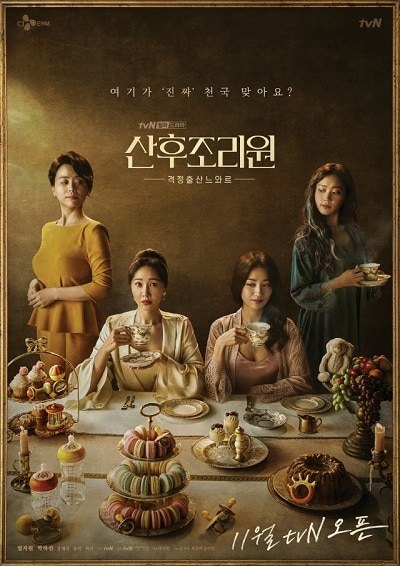
Korean Title: 산후조리원
Aired in: 2020 (8 episodes)
Channel: tvN
Grade: 10/10
Actors: Uhm Ji Won, Park Ha Sun and Choi Ri
For more…
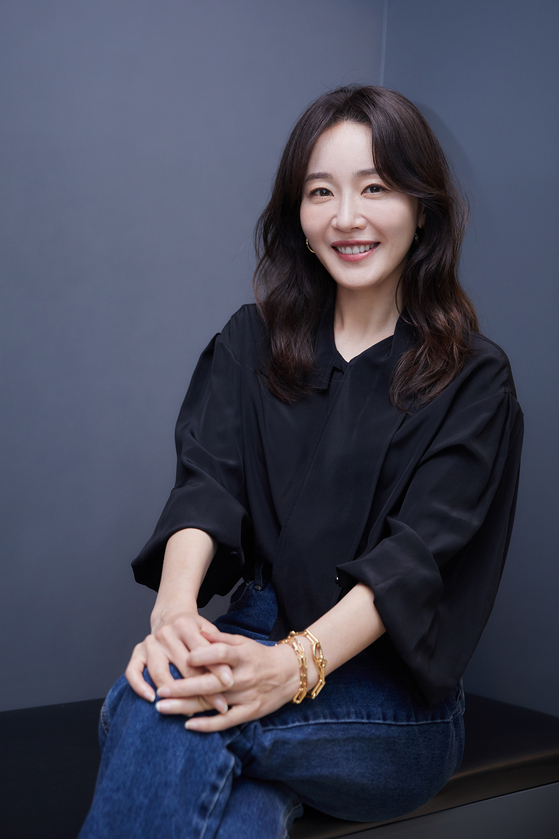


Uhm Ji Won:
– Falsify
– The Cursed
– Spring Turns to Spring
– Can Love Become Money
Park Ha Sun:
– Love Affairs in the Afternoon
– Two Weeks
– Drinking Solo
– Temptation
Choi Ri:
– My First First Love 1&2
– Witch’s Court
Analysis
Synopsis
Oh Hyun Jin just gave birth to her baby and stays therefore in a postnatal care center with her husband. There, she meets other mothers such as Jo Eun Jung and Lee Roo Da, who happen to have very different views on maternity and motherhood.
My Opinion (No Spoilers)
Incredible drama, I loved it! I usually love series, dramas and movies that dare talk about pregnancy, giving birth and in general parenthood. Though it used to be kind of taboo, I am very glad to see that more and more fictions, especially in South Korea, are willing to open up on these subjects.
The drama is thus very relatable and gives a broad picture of the ups and downs of parenthood, either it’d be mothers’ or fathers’ difficulties. What I loved the most was that it simply never judged or shamed any character, fulfilling its original purpose: demystify and deconstruct preconceived ideas on the matter. Through humor and warm-hearted relationships, we are given the opportunity to fully empathize with the characters, while learning more!
Mothers and fathers out there, free yourself from guilt, fear and apprehension! This drama will simply empower you!
Analysis (Spoilers Alert)
Here are some the great themes that Birthcare Center manages to tackle with finesse, wit and a whole lot of humor:
Having a child late: Our story starts with Oh Hyun Jin (Uhm Ji Won), a career woman, who is the younger executive at her company. She excels at her work, is competitive, career-driver and will do anything to seal the deal with her clients. She is stubborn and determined, but can sometimes appear cold and distant.
As she has always put her career before the rest, it is no wonder that she gets pregnant “older than the average”. Indeed, we learn that she is closer to her 40s than her 30s, which naturally puts her in the category of risky pregnancy. Though she doesn’t seem to realize it at first and keeps working until her water actually breaks (yes, it happened with a client!), she is thereafter confronted with a number of uncertainties, exacerbated as well by her “advanced age”. How old will she be when her son reaches his 20s? Technically, she will already be considered a “grandma”! Will she still be there for her son throughout the various events of his life (wedding, grandchildren…)? In what state (physical and mental) will she be in when her son becomes an adult?
All of these questions remain constantly in Hyun Jin’s mind, worsening her insecurities. No to mention of course that among all the mothers present at the clinic, she is also the oldest. This, once again, increases her worries.
Naturally the drama manages to lessen, if not eradicate, these fears of hers, and even better, it never points out or stigmatizes mothers, who would choose to have children later in their lives. On the contrary, it sheds light on the fact that it is not a problem in itself and that being older is absolutely not synonymous with being a bad mother. Through Hyun Jin’s funny and anxious dreams, Birthcare Center shows that it is okay to be pregnant late and that age is in fact just a number.
On this same dynamic, it also emphasizes that age gap between two spouses (Hyun Jin is older than her husband) is not a problem either. No matter the number, it doesn’t determine whether or not you are and/or will be a good parent.
Being a working mom: As mentioned previously above, Hyun Jin loves her job. Her entire life revolves around it (of course before the birth of her son) and she worked hard to get where she is. However, when she arrives at the postnatal clinic, she encounters a certain number of mothers, who are housewives and have decided to put their job aside in order to take care of her children. Among them, I remember that Jeon Yoo Rim’s (Choi Ja Hye) case really struck me. Indeed, she is a brilliant scientist who stopped her promising career for her kids!
Yet, the embodiment of the “perfect housewife” is surely Jo Eun Jung (Park Ha Sun). She is the mother of twins and has just given birth to her third child. She is seen as the “Perfect Mother” in all regards by the rest of the crew. Though Eun Jung seems to have it all, she is in fact full of insecurities that she disguises under a veil of self-confidence and perfection. She is judgmental and behaves literally like the Queen Bee, while hiding dark secret behind her mask.
Indeed, by the middle of the drama, we actually get to discover a new side of her personality, one that is vulnerable and soft, especially through her special friendship with Ha Kyung Hoon (Nam Yoon Soo), the delivery man. Their tender relationship starts off the wrong foot, with her being trapped in his delivery truck. Despite that and Eun Jung’s obvious refusal to have any kind of friendship with him, she happens to find a supportive shoulder to lean on, when her twins make her life actually impossible. As the perfect housewife, she is too afraid to break her image of a loving mother, wife and beautiful woman. She is therefore very lonely, when it comes to taking care of her twins. These two kids are terrible monsters, full of energy, who make all nannies run away and leave Eun Jung to her terrible fate. Considering this situation and the fact that they made all of her friends run away as well, Eun Jung ends up questioning her capacity as a mother and feels trapped and silenced. Fortunately for her, she is able to find comfort and support in the figure of Kyung Hoon, as well as in the other mothers, to whom she opens up gradually.
In fact, it doesn’t matter in the drama whether you choose to be a housewife or a working mother, the drama once again is not here to judge and neither is the community of the center. What Birthcare Center really focuses on, is the fact that all mothers make choices, for themselves, for their children and for their family. Yet, there are no good or bad choices, as long as you are willing to take responsibility for them.
Also, I actually loved the fact that each episode taught us more about the different mothers that were present at the clinic. It didn’t only highlighted the struggles of the three main leads, but also shed light on various characters, showing that each mother has a distinct profile and personality.
Breastfeeding vs formula: Apart from tackling work and pregnancy in general, which are already two important themes related to parenthood, I believe that the drama reanimated the ever-lasting fight of breastfeeding versus formula.
I am not here, of course, to say what to do or what should be done, because, once again, it all depends on the mother and her wishes. When most of the mothers led by Eun Jung preach breastfeeding as the one and only solution to nurture their baby, Hyun Jin struggles doing so (because mainly of physical difficulties), while Lee Roo Da (Choi Ri) is the strongest advocate of formula, shocking the rest of the community, including her mother-in-law (the clinic’s director).
Lee Roo Da, despite her young age, is assertive and strong-minded. Se knows what she wants and doesn’t, she doesn’t seem to be animated by her “roommates'” debates and intends to lead her life the way she wants to. She doesn’t care about what others say, which puts her at the extreme opposite of the gang led by Eun Jung. As for Hyun Jin, she seems to be the outcast at first, incapable of fitting in the group and feeling isolated, until Lee Roo Da arrives.
Anyway, this debate over breastfeeding and formula manages to give place to serious confrontations between our favorite mothers, adding even more humor to the story.
Dealing with changes: What would be a drama about parenthood without talking about all of the insecurities that go with it?
I am not really going to teach you anything here I think, but after giving birth, women’s hormones are all over the place, their bodies are completely different and they have to deal with a certain number of changes. Well, don’t worry, because Birthcare Center is here to put your worries to rest. Either they’d be related to having sex after the birth (Hyun Jin and Kim Do Yoon (Yoon Park)’s situation is rather comical), physical pains (most of the mothers walk around with a cushion because of their perineal pains), suffering during labor (the first episode is a perfect deconstruction of the myth around childbirth) or postpartum depression, everything will have its moment in the spotlight.
I was actually really fond of the drama’s courage to talk about these themes, that often tend to be forgotten, when talking about pregnancy and its aftermath. Even though, the drama used humor and fiction to depict many consequences of having a child, I believe it is extremely important to keep talking about them. Women, and parent in general, should be sensitized about these things, no matter if they were good or bad experiences. Parents should be informed in order to be better prepared and perhaps avoid the fears and misconstructed ideas revolving about their new parenthood. Lifting the veil off taboos, even through fiction, is an incredible tour de force of the drama.
Dealing with overweight: Once again, I am not going to teach anything here I think, but many women take on weight during their pregnancy. For some, the weight is easily lost, for others, it proves to be more difficult. Also for some, the impact on their own perception is almost non-existent, while for others, the psychological effect can be devastating. The drama manages to get women rid of their guilt, by telling them that it is okay to put on weight. You don’t need to please anyone else but yourself and if it takes more time for your body to get back on track, because you wish it so, then it’s fine. A lesson proudly given by Han Hyo Rin (Park Si Yeon), who plays an “overweight” celebrity because of her pregnancy.
Being a good mother: Naturally all of these insecurities find their natural origin in the following question: what does it mean to be a good mother? Frankly, I doubt there is ever going to be an answer for that. However, what the drama appears to put forward is the fact that your love for your child and your will to give him everything he needs already make you an incredible parent! You don’t need to buy them luxurious items or to be physically perfect, as long as they are happy and you are happy, you already check most of the boxes.
Of course in the drama, parents tend to think that they need to do more to satisfy their children, like finding the best nanny. Yet, this is another construction in parents’ mind.
Parallel to that, the various profiles of mothers, with their own views (Roo Da and Eun Jung’s being quite opposite) on motherhood, are just the perfect representation of the various scenarios you’ll find out there. All of them have their own educational ideas, very distinctive from one another. Despite that, they still form a united front, when it comes to loving their baby, turning all of them already into great mothers.
Fatherhood: It is true that the drama focuses a lot on mothers, yet it hasn’t forgotten the other important figure: fathers. I was very glad to see that fathers were also included in the plot, as, let’s not lie, they are quite the significant figure.
Indeed, not only women go through changes when having a child. Even if their body doesn’t physically change (or at least not that much!), they don’t have this roller coaster of emotions induced by hormones, having a baby is also a very big deal for fathers too. Mostly considered as heads of the family, they are most of the time charged with more responsibilities, what the drama perfectly shows when Do Yoon and Hyun Jin’s baby is kidnapped. While Hyun Jin seems lost and unable to act, Do Yoon stands as her pillar and support, willing to protect his family and get his baby back.
Apart from being more responsible, fathers also have to navigate through their wife’s humors and emotions, trying to find a balance in order to support them without attacking them. Hyun Jin and Do Yoon’s couple is the epitome of that difficult task, as Do Yoon tries his best to please his wife and often has to endure her insecurities (of course, this is not a criticism, it was just so funny and sweet to see Do Yoon trying his all to make Hyun Jin happy and not be upset, even when she was pushing him away!). Their dynamic and couple worked perfectly and I just loved seeing how compatible they were!
At the opposite side of the spectrum however, Eun Jung’s husband seems to be the least supportive one. Constantly working (he is a golf player) and pushing her into doing interviews, he doesn’t appear very considerate. This is one of the main reasons why Eun Jung feels so alone, left with the kids to take care of and forced to assume everything by herself. It also explains why she is attracted to Kyung Hoon. She finds in him the help and comfort her husband deprives her of.
I was actually really mad at Eun Jung’s husband’s behavior for not seeing, or not wanting to see, that his wife was at her wit’s ends. She was crumbling little by little and he wasn’t able to see that. Fortunately by the end of the drama, Eun Jung and her husband finally have THE talk, in order to set things right. We thus get a better understanding of her husband’s behavior. Seeing how is wife seemed capable of doing it all, because she was not showing or telling him she could not anymore, he didn’t do anything. Of course, if I may say, they both partially responsible in that matter: one for not paying attention (the husband) and one for not communicating (Eun Jung).
Losing a child: Though the drama is meant to be funny and light-hearted, it still dared to tackle more serious themes, on a different scale of gravity. If the inability to create a link with your baby appeared early on in the drama, the story turned into a tragic/criminal one when Hyun Jin’s baby is kidnapped, revealing an even darker secret.
Indeed, among the mothers present at the clinic, Park Yoon Ji (Lim Hwa Young) is desperately hoping for her baby to get better at the hospital. If the story ends tragically with her losing her child, the story pictured properly the kind of reactions such news can lead to: deep grief, trauma and mistaking your baby for another one.
Though this theme was clearly more heartbreaking, it is still a reality and potentiality in a parent’s life, which deserved, at least, minutes on screen.
Celebration of parenthood: All in all, Birthcare Center is a celebration of parenthood, aiming at depicting realistically, or almost as such, situations you are bound to live as a parent. It also highlights the need for support, talk, and presence after childbirth, all of that embodied in the drama through the figures of Hyun Jin’s mother and the director of the clinic, who have been mothers as well, and fathers wandering around the clinic, giving advice to new ones. The drama shows that taking care of a child is a knowledge transmitted from generation to generation and that all parents are, at the same time, distinct and similar.
Being a woman: The drama show also that being a mother doesn’t prevent you from being a woman, with desires (to be seen, loved, admired and wanted), what the story humorously reveals.
Humor and feminist vibe: Finally, I can’t finish that review without mentioning the subtlety of the writing, expressing with tenderness, benevolence and affection the difficulties of becoming a parent, while making no judgement. It is a call for all mothers and fathers to let go of the burdens they create for themselves.
P.S.: The drama had great cameos such as Cha Tae Hyun, So Ju Yeon and Han Hyo Rin!
 Once Upon a Drama