Presentation
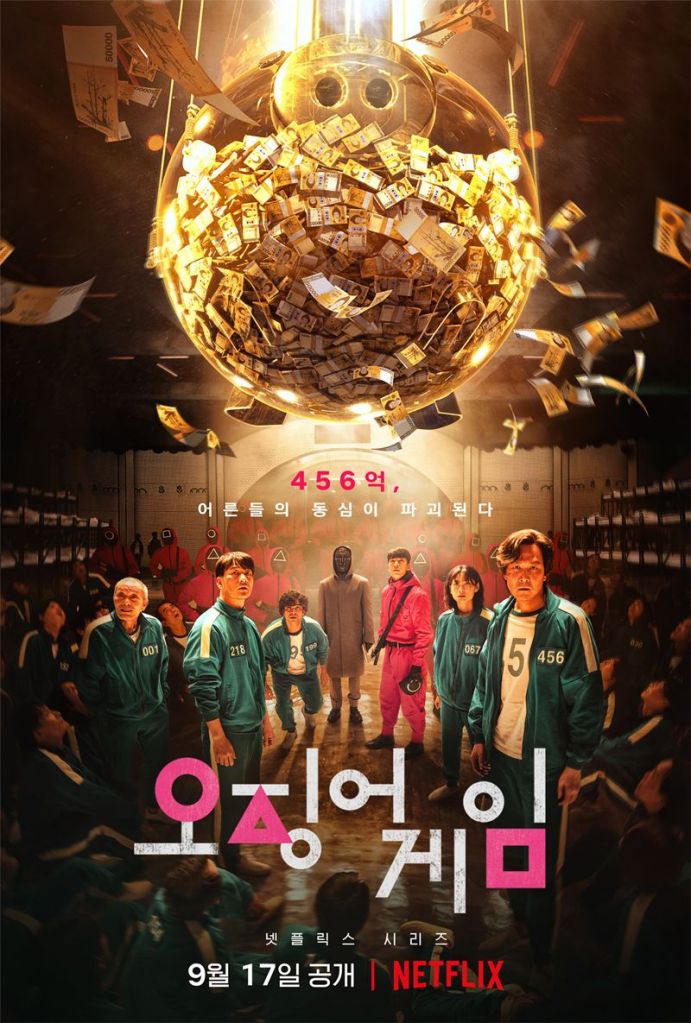
Korean Title: 오징어 게임
Aired in: 2021 (9 episodes)
Channel: Netflix
Grade: 10/10
Actors: Lee Jung Jae, Park Hae Soo and Jung Ho Yeon
For more…


Survival games:
– Alice in Borderland (Japanese Netflix series)
– Battle Royale (Japanese movie)
Analysis
Synopsis
Gi Hun is going through a tough time, after getting fired from his job. He hears about a survival game that has a reward of 45.6 billion won for the winner. Cho Sang Woo has grown up alongside Gi Hun and also faces a financial crisis. Both participate in the game, like many others, without realizing what the game is actually about.
My Opinion (No Spoilers)
Excellent drama! That’s the only thing I have to say. Although I was a little worried at first that Squid Game would look a lot like other survival series (such as the amazing Alice in Borderland), I was quite surprised (of course positively). It managed to find its own narrative and to set itself apart from other series on that topic.
The acting performance was incredible, the visuals were beautiful and the games crueler than ever. Yet, I couldn’t stop watching it. If you have some time to spare to play some games, I highly recommend you tune in for that drama!
Analysis (Spoiler Alert)
Characters:
Seong Gi Hun (Lee Jung Jae) is a middle-aged man, who lost his job due to abusive lay off. Over night, he lost everything. This destroyed his marriage with his pregnant wife, and his life. He buried himself in debt, used his mother’s shop as a collateral and started a life full of despair and misery. His ex-wife remarried so he can only see his daughter from time to time. Meanwhile, he learns that his mother suffers from diabetes and needs to be treated.
In order to get his hands on money, Gi Hun gambles on horses. Unfortunately, he often loses. Hitting rock bottom, Gi Hun meets a man in a suit (Gong Yoo) at the train station. After a game, he gives him a card with a phone number, offering him the possibility to win a hefty sum of money.
Seeing a bit of light at the end of the tunnel, Gi Hun agrees to participate. Basically, Gi Hun enters the game for reasons other than greed and self-interest. Indeed, he wants to provide his daughter with a financially stable environment and get money for his dying mother. In the game, Gi Hun is actually the perfect combination between good and evil. He always wants to see the best in people, wishes to trust (but keeps his reserve) and refuses to stomp on others to succeed. Somehow, this spirit allows him to team up with the right person at the right moment, but also plays against him by the end of the drama. Also, he is probably the unluckiest player of the game, but is always saved at the last minute. He embodies good in that arena, especially at the end, when he refuses to kill Cho Sang Woo (Park Hae Soo) to win. Moreover, he makes a promise to Kang Sae Byeok (Jung Ho Yeon) and Sang Woo to take care of their family, which he does.
If Gi Hun started as a kind, if not naive person, his aura has darkened in the last episode. Either eaten up by guilt and remorse, or animated by anger, the game has transformed him. It made him stronger, more vengeful, but he hasn’t entirely lost in faith in humanity.
Contrary to the good-natured Gi Hun, his childhood friend Sang Woo is the perfect epitome of the sentence: “The end justifies the means”. Sang Woo is brilliant (he went to SNU), but made bad gambles and left him with a lot of debts. He is cynicism embodied. He doesn’t have scruples and is definitely more realistic than other players. The outside world has become his Hell and he would rather die than go out. It seems as if Sang Woo had lost faith in humanity, therefore killing people without too much trouble, or tricking his so-called friends like Ali. He is the perfect opposite of Gi Hun. Yet, at the end, Sang Woo accepts defeat and his fate. He does one last act of kindness towards his friend by sacrificing himself in the arena. Personally, this gesture made me see Sang Woo in a brighter light and he won some points at that moment.
Kang Sae Byeok is a young woman, who decides to enter the game for the sake of her family, more precisely her younger brother. As defector from the North, Sae Byeok is aware of the brutality of the outside world. Nothing in her life has been easy, she learned to survive alone, to rise up and to fend for herself. Therefore, she doesn’t trust anybody. She also has a lot of enemies like Jang Deok Su (Heo Sung Tae), inside the arena. Her distrust of people, on top of her “weak” physical appearance put her at disadvantage in the game. However, she ends up trusting Gi Hun, indirectly providing her brother with a protector, but dies unluckily because of a piece of broken glass. I could only think that if Sae Byeok hadn’t had to live in the harsh world by herself, she would probably have been more like Gi Hun: naive, clueless, kind. Things that we get to see from time to time by the end of the drama.
Other players are interesting: Han Mi Nyeo (Kim Joo Ryung) is very resourceful and vengeful, but trusts too easily; Deok Su has the physics to scare people away and the leadership skills, but he is a coward; Ali (Tripathi Anupam) is too clueless, sacrificial, team player and kind, despite looking like a rock.
Ambiance: The Art Director did an amazing job at creating the settings. Whether it’d be the colors, the sets, the geometry, all of that contributes to the aesthetics of the drama and its perfect visuals. It really propels us in this strange place and emphasizes some symbols and meanings of the childhood, the game or the structure. On top of that, the direction is simply flawless, reinforcing the tense and dark atmosphere of the drama. Well done! Not to mention the childish music in total contradiction with the horror of the games, and the “Blue Danube” that has now become my nightmare!
What are the themes tackled?
Even though Squid Game seems to be a simple series about contestants fighting for their lives in an arena, it actually tackles a lot of different topics. Meanwhile, it delivers them using strong and meaningful symbols, that I believe need some clarification.
Critical view on society: Of course, the drama is just a mirror of society and a criticism of its problems. On many occasions, the system has failed people. They have become victims of it, unable to get their head out of the water. The intelligence of the creators reside in their use of the system to make the game possible. It plays with people’s weaknesses and vulnerability, their despair and greed for success. It basically opposes two contradictory sides: the rich, who play for fun, and the poor, who play for life. In-between these extremes, an entire hierarchy has been reproduced with the Front Man In Ho (Lee Byung Hun) wearing a grey mask, then those with a triangle mask, then a square mask and finally a circle mask. Each of them is assigned to specific roles and tasks, just like in society. Moving from one step of the ladder to another is extremely difficult, and could also be dangerous. Only two people actually manage to do so: Gi Hun, by winning the game, and Jun Ho by infiltrating the network anonymously.
The drama also asks a very simple question: How far would you go for money? In that case, there are multiple answers, but certainly not trust in values like solidarity, mutual aid and altruism.
Reflection on equality: The drama offers a serious reflection on equality throughout its episodes. As mentioned by In Ho (the Front Man), everyone is supposed to play fair and square, that is using their own abilities. The reason? Because society has abused contestants by not giving them proper chances to succeed (distinctions in wealth, education, family….). The logic of the game is thus that you win with your skills. Although the idea seems justified at first, the more I watched the drama, the more I realized that equality was just a chimaera. Indeed, if players are all on the same level, the fifth game actually shows a great discrepancy, and therefore injustice, between players and game masters/VIPs. For example, at some point, a man manages to use the light of the setting to distinguish the tempered glass from the normal one. Realizing that his skill and experience are taking the fun out of the game, the Front Man alters the rules and forces him to play differently. From that point of view, it is clear that equality is not achieved at all. Players (the poor) remain puppets in the hands of the rich, just like in the outside world, where the latter decide on the rules. The island where the games take place is just a microcosm of the outside society, in which the wealthiest decide, and the others have to abide by their rules.
Reflection on free will: Just like for equality, Squid Game also allows for a greater debate regarding the existence of free will. Indeed, one can affirm that no one (nor the man in the suit, nor the host) forces contestants to play. In the second episode, after a democratic vote, players are all freed without question. However, most of them choose to come back. Once again, no one forces them to do so. On that matter, we could thus argue that participants have free will and are given the opportunity to decide what’s best for them.
However, I thought that the drama revealed a much darker vision of that supposedly free will. Yes, most of them chose to come back, but that is only because the possibilities outside are worse. Episode 2 entitled “Hell” does an incredible job at showing how stuck many of them are; how Hell is not the game, but their reality. So,
we can say that on an individual level they technically have free will, but in the end, circumstances force them to take a gamble and go back to the game. That’s their only escape.
Critical view on human nature: To make the game possible, the creators decided to rely on human beings’ most basic, if not worst, instincts. They use vices like greed, anger, betrayal, revenge and survival instinct as triggers for the game. Many scenes of the drama such as the night bloodbath or the numerous sacrifices of others to be the last one standing, are examples of this critical view on human nature. People are considered not as reasonable humans, helping each other and teaming up; but as beast, willing to do anything to survive. The reason behind? Well, quite easy: Society as it is, turned them into beasts. It forced them to become the worst version of themselves. They didn’t have the opportunity to learn kindness, selflessness or generosity, especially if you consider the environments they had to evolve in.
On that matter, human nature is destroyed, there are no human values, laws are that of the jungle. The vision is rather dark and pessimistic. Indeed, even those who are good, end up being betrayed in the end (take Ali for instance and his kindness). Moreover, the fact that most contestant choose to come back in the game, or/and refuse to stop it afterwards, is yet another proof of their greed. After all, they are still betting on a potential victory, no matter if there is only a 1% chance.
However, the drama also offers a ray of hope. At the end, Gi Hun plays a last game with Il Nam (Oh Young Soo) on his deathbed. They bet on a drunk homeless man, lying outside in the freezing weather. Il Nam is convinced that no one would come to his rescue, while Gi Hun affirms that humans are good by nature and that someone will reach out to him. On the last second, another actually helps the dying man on the sidewalk, proving that humans can be good. Despite that, hope is still feeble, as it happens on the gong.
Cycles: The drama is built on a series of cycles. Three in particular stand out:
1. From number 1 to number 456 to the re-encounter of both characters Il Nam and Gi Hun at the end. There is an evolution/transformation for Gi Hun, who won all the money. Despite that, he is back to square one, leading a miserable existence, full of despair and emptiness. The only thing that has changed is the money in his pocket, that he hasn’t touched for a year.
2. The arena from the 1st game is the same as that in the 6th game. Once again in that case, Sang Woo and Gi Hun have to fight for their survival. Yet, there is an evolution here, since the environment and characteristics of the game have changed. In the 1st game, there were a lot of contestants (as well as a lot of deaths). Players were only discovering the principles of the game. In the 6th game, Sang Woo and Gi Hun are more than aware of the dynamics of the game. They are the last ones standing. Moreover, they are playing against each other this time, and not against the game masters. This emphasizes the cruelty of the game (they are childhood friends) and precipitates the tragic ending: only one can survive.
3. The third cycle has to do with the overall intrigue. In the first episode, children are playing the squid game, while the voice off explains the violence of the game and how it actually works. The drama ends with a final fight between Sang Woo and Gi Hun, playing the squid game. Some elements have also changed there: These are adults and not children; the struggle is real (you fight to death). To me, this cycle is the most explicit one, illustrating that the squid game is actually a mirror of society. You fight against each other to survive. If the game for children suggested that idea at first, the final part sets it into motion completely.
Innocence is long gone: The squid game sheds light on the brutality of the world right from the beginning. Also, all the other children’s games do the same in their own way. If they were meant to be innocent in the first place, they actually are quite useful to understand the ways of the world.
First Game: Green Light, Red Light
In that game, you have to be quick, agile, cold-headed if you wish to survive. The goal is to run, while the doll shows its back. Once it turns its head, you have to stop. If you move, you die.
On a societal level: rapidity, cold-headedness, agility are all qualities you need to adapt to your environment, no matter how hostile it can be.
Second Game: Honeycomb
This second game interestingly relies on your luck, something that you can’t really control, but also on your wits. Indeed, out of the 4 forms, Gi Hun ends up with the umbrella. To make it work, he decides to lick the piece so that it won’t break the form.
On a societal level: Wits are important, they can get you out of any uncomfortable situation. At the same time, the game also reflects other contestants’ behaviors. Some cheat using previous information or objects they have brought with them (Han Mi Nyeo has a lighter), others simply copy Gi Hun to survive. Clearly, players, taken as a whole, represent society itself: how some bend the rules to survive, how others copy, how some are just eaten by the environment.
Third Game: Tug of War
At first sight, it seems like this game relies entirely on contestants’ strength. Thus, some teams have an advantage, as their members are mainly well-built men. The first teams confronting each other appear to validate this basic principle. However, Gi Hun’s team is the perfect example that strength is not the only element that matters. Indeed, strategy here plays a crucial role, enabling his team to win despite having three women and an old man. The reason is simple: you need to balance each member’s strength and come up with a bulletproof strategy, that can overthrow pure physical strength.
On a societal level: Once again, sometimes the odds are not always in your favor, when you team up with strangers. However, this game emphasizes the importance of a good strategy and teamwork. The more you understand each member’s value, the stronger you become. This game puts forward how experience and reasoning are important in life, and how leaning on others can sometimes help you move forward.
Fourth Game: The Marbles
In this game, each contestant has a bag of 10 marbles. The goal is to play games and to win the other’s 10 marbles.
On a societal level: This game insists once again not only on luck, but also on strategy. Strangely, most of the participants decide to play a game of even-and-odd, when games based on dexterity and aim could’ve been a solution. This can illustrate how people always tend to rely on luck rather than their own skills, hoping that it will get them out. Moreover, this game is probably one of the cruelest of all, since it forces you to blindly team up with a “friend” and to betray him in the end, using manipulation, tricks and lies. Look at Sang Woo and Ali for example, or Gi Hun and Il Nam. Metaphorically, this game refers to the basic human instinct that pushes you to betray others and to use their strengths or weaknesses (Ali’s kindness/naivety; Il Nam’s dementia) against them. Once again, you shouldn’t trust anyone in this game and should always be on your guard.
Fifth Game: The Glass Bridge
I have to admit that the concept of that game is quite intelligent. The idea is to basically take a leap of faith by jumping on either glass in front of you, and see where it leads.
On a societal level: The game makes the beast come out of everyone. You either push the one in front of you, step on him, jump with him for revenge (Mi Nyeo and Deok Su), or cowardly wait until time is up. It is savage and violent at the same time. Meanwhile, this game also sheds light on a basic principle: in the face of the unknown, you’d rather pack with the herd by taking numbers in the middle (from 5 to 11), but never choose to be last or first. In that case, Gi Hun failed at making a decision, leading him to be the last. Luckily, it saved his life.
Sixth Game: The Squid Game
I don’t think I need to explain more about this game. You basically fight until death.
On a societal level: The stronger survives, except in that case. Indeed, even though Gi Hun has won in the end, he refuses to be responsible for Sang Woo’s death. He would rather stop the game here and leave without the money. Unfortunately for him, Sang Woo disagrees and prefers to die rather than to go back to his life outside. It is lex talionis by excellence, but also demonstrates sacrifice, something that some people are willing to do to free themselves from the fiery pit.
In all cases, the arena transforms men and childhood memories in order to reflect the real and brutal face of the world we live in.
Morality: Interestingly, the drama is pretty confusing, when it comes to morality. There is absolutely no dichotomy, no black or white, no right and wrong. The entire intrigue evolves in a constant grey area, allowing for various moral values to confront themselves. If the game in itself is wrong and shouldn’t have been created in the first place, it is still difficult to totally discredit it. Indeed, as mentioned previously, it takes advantage of the failures of society, that cast aside people and gave them no choice but to participate. Moreover, the game master and the host technically never really forced contestants to be there. From the get-go, they are given a possibility to take part in the game. Even after, when they all vote to terminate the game, many of them come back on their own accord. On top of that, game masters assure equality of chances between participants. Hence the killing of those revealing what the next game will be.
Is there really a winner?: If Gi Hun ended up winning the hefty sum of 45.6 billion won, we can’t really say that it was a satisfying win. Indeed, it is actually dirty money that he got at the expense of others’ lives and despair. Meanwhile, the game not only took the lives of many people, but it also robbed Gi Hun of his last moments with his mother. In the end, he may have gotten the reward, but his existence has become meaningless and empty. He is all alone: his daughter has left for the US with her mother and stepfather; his mother died, while he was away; he lost his childhood friend Sang Woo and others he had met in the arena like Sae Byeok. On top of that, he is eaten away by guilt. Did he really deserve to win? Was it worth it? Well, by the end of the drama, it seems like money doesn’t make happiness at all. Can’t say there is a real winner (apart from the creators of the game).
This question is also accurate, when you think about the way Gi Hun won. In the first game, he survived thanks to Ali, who prevented him from moving and being killed on the spot. In the second game, he got lucky too by licking the honeycomb. In the third game (Tug of War), he owes his success to Il Nam’s experience and Sang Woo’s quick reflection. In the fourth game, he only got away because he tricked Il Nam and used his dementia against him to win more marbles. Finally, luck was on his side in the bridge game since he was last to play and in the sixth one, Sang Woo killed himself. Gi Hun’s win has thus nothing to do with his own skills, but rather with his luck. Only because he was luckier than others (regarding his position in the game and his teammates for instance). This makes the win even more bittersweet.
Meaning of the numbers: I wish the screenwriter or the director could tell us more about the chosen numbers for each contestant (if of course, they have a certain significance). The only meaning I can clearly discuss about is that of the number 1 (given to Oh Il Nam) and the number 456 (given to Gi Hun).
Indeed, as revealed later on in the drama, the old man Oh Il Nam happens to be the host of the show/the creator of the games. Plus, he confesses at the end of the drama, that he wanted to participate in the game to have some fun. Knowing its existence long before others, and wishing to be a part of it, it would only makes sense that he was the first one to register for it. Moreover, being number 1 could also refer to the fact that he is at the top of the pyramid. He is the wits behind the game, the head of the hierarchy.
As for the number 456, it is quite relevant to link it with the reward: 45.6 billion won. We could suppose that Gi Hun’s number predicted his future win, since the amount of money corresponds to his number. Moreover, he is also the last one to join, and develops a peculiar relationship with the old man Il Nam. Therefore, their respective numbers could be a metaphor, not only of their position in the game (the creator versus the contestant), but also of their social position in society. Indeed, Il Nam is filthy rich, whereas Gi Hun is filthy poor and indebted. Yet, through the game, Gi Hun succeeds in climbing the social ladder, but to what price?
Double narrative: The dynamism of the drama naturally comes from its breathtaking and shocking games, but also from the double narrative that takes place. Right from the start, detective Hwang Jun Ho (Wi Ha Joon) starts looking for his missing brother. Almost coincidentally, he hears about that survival game. One clue to another, he succeeds in infiltrating the game, quite brilliantly to be honest. The viewer is thus taken by the different games, but also by the uncovering of the organization behind those games. Episode after episode, Jun Ho learns more about the games, when they started, who is involved, how they created the arena… The end is bittersweet for Jun Ho, when he discovers that his brother In Ho is none other than the man with the grey mask (the Front Man). Parallel to that, he tries to contact his colleagues and send them evidence regarding the existence of the game, but the outcome remains mysterious.
Comparison with other survival series: I think a quick comparison between Squid Game and other survival series is in order, considering that many criticized the Korean drama for plagiarizing other successful works. To discuss this, I will talk about two Japanese survival games, that seem to be like the drama, but that are actually totally different. Also, I highly recommend these two.
Alice in Borderland: This is a Japanese Netflix series that tells the story of a young man Arisu, who is suddenly transported in an empty Tokyo with his friends. The capital is empty and there are many arenas, where participants play. Each win allows them a 3-day rest, meaning that they don’t have to play again during that time. Each game is naturally deadly and relies a lot on wits, strategy and thinking. The number of contestants varies and there is no reward, apart from cards. I won’t tell you more about it to avoid spoilers, but by the description of the plot, I guess you can see the difference with Squid Game.
Battle Royale: On a school trip, a class of students is kidnapped and forced to play a deadly game in which only one can survive.
Differences:
Squid Game = One arena (the island), 6 games, 456 participants, a reward of 45.6 billion won, choice to participate or go out, if you win you go back into the world, the face of the creator and game master are known, the reason behind the existence of the game is given, many information about the structure of the game (masks, colors, forms…).
Alice in Borderland = One arena (Tokyo), unlimited amount of games that you choose when you enter an arena, you get a card if you survive and there can be many survivors, Arisu and others are forced to play, they know nothing about the game, its creators, the game masters, the leaders or why they were chosen.
Battle Royale = A class of students, we know why they were chosen and who chose them, students have different weapons (no fairness like in Squid Game), no set arena, there are no games just survival, no definite hierarchy nor structure.
Questions to be answered in a potential Season 2: The last episode of the season left me with some burning questions and hope for a second season. Here are some elements that need to be addressed:
– Will Gi Hun join the game again?
– Will he get more information about the organization and the creators? How so?
– How long have the games been going for? (At least 1999 according to the first season)
– Who are the VIPs?
– What is In Ho’s story? From what we know he won the 2015-tournament, but where is the money? Why did he join as Front Man?
– Is Jun Ho dead, missing or not?
Cameos: As if seeing Gong Yoo in the first episode were not enough, I was actually more than delighted to see Lee Byung Hun as Jun Ho’s older brother. The moment he took off his mask and revealed his face was as shocking as amazing. These two incredible actors really added to the overall success of the show with their flawless acting.
 Once Upon a Drama