Presentation

Korean Title: 피라미드 게임
Aired in: 2024 (8 episodes)
Channel: TVING
Grade: 10/10
Actors: Bona, Ryu Da In, Jang Da Ah & Shin Seul Ki
For more…



Bona:
– Girls’ Generation 1979
– Your House Helper
– Twenty-Five, Twenty-One
– Joseon Attorney
Ryu Da In:
– 18 Again
– Crash Course in Romance
K-Dramas with terrifying games:
– The 8 Show
– Squid Game
– Night Has Come
– The Roulette: No Way Out
Overview
Synopsis: Sung Soo Ji transfers to a new high school in Seoul. One her first day, she has to participate in the Pyramid Game where students vote for each other. The person with the lowest vote gets bullied for a month by the rest of the class. Soo Ji is voted out and bullied. Meanwhile, she tries to put an end to the game.
My Opinion (No Spoiler): This drama was spectacular! First, I need to take about the plot because it’s really what makes you want to press the ‘Next episode’ button. The drama is so well-written with a fast and suspenseful narrative. It feels like watching a chess game where Soo Ji and Ha Rin are the Queens fighting for dominion. Each episode brings about a new interesting thread of the story that, once pulled, can change the entire dynamic in the classroom. Alliances between students also play a crucial role, but they are only possible because of Soo Ji’s charismatic aura or Ha Rin’s threatening presence. Second, characters are amazing. My preference naturally goes to Sung Soo Ji, but she’s not your typical heroine. She has her faults and that’s exactly what makes her appreciable. Others, like Ja Eun, Do Ah and Ye Rim will surprise you too. Third, the friendships and relationships between bullied students depicted in the drama are credible and relatable. Who knows how one would react if one were forced to play the Pyramid Game? All of these girls show a different aspect of human nature, which makes the story even better. Finally, I can’t finish this review without mentioning the villain: Jang Da Ah. I think she delivered a good performance for a rookie actress with no experience, and made her character believable until the end. All in all, if you’re still doubting whether to watch this drama or not, don’t anymore. Pyramid Game is an excellent pick with 10 eps of only 50 minutes full of twists and turns that will keep you on the edge of your seat. So, will you play it?
Analysis
- Characters
Sung Soo Ji, the game changer
Myung Ja Eun, the root cause
Baek Ha Rin, the Queen bee
The unexpected helpers
The new friends - School as a mini-society
- The Pyramid Game
- Good versus bad
- Other topics
Domestic violence
Homosexuality
Father-daughter relationship - OST
Characters: One of the drama’s greatest assets is its characters in my opinion. At first glance, these high school girls all have different personalities that split them into groups, either at the top or at the bottom of the pyramid: Popular kids, leaders, followers, cowards, bullied students, and undecided rebels. Though it seems impossible to break the dynamics of the groups at first, the arrival of the transfer student entirely disrupts social order.
Sung Soo Ji, the game-changer: Sung Soo Ji (Bona) is by far one of the best characters I’ve seen in a school drama. Upon her arrival at Baekyeon Girls’ High School, she’s cold, distant and calculating. She’s transferred so many times in the past (due to her father’s job in the military) that blending in has now become a piece of cake for her. She just needs to observe relationships and play her cards accordingly. Her perspicacity allows her to pinpoint the queen bees and the weak ones from the crowd. However, it doesn’t take long before she realizes that the dynamics of this school are broken. Rules are rigid, while students remain at the place they’ve been assigned to without an ounce of rebellion at the horizon. That being said, Sung Soo Ji will become the rebellion. Being the outsider who’s bullied right from her arrival, she challenges the rules and goes against the established order. Her abilities to sway students and her quick-wittedness enable her to destroy the pyramid from the inside.
Interestingly, Soo Ji also grows while fighting. As a transferred student, she’s never been able to create bonds with others. Her friendships have always been ephemeral and inconsistent, causing her to lose them at her next transfer. That’s why, she’s not keen on getting involved in the ‘riot’ at first, even less in leading it. Gradually, she matures and goes from a lone wolf to the leader of the pack. She nurtures her friendships, becomes more open-minded and tries to put herself in her friends’ shoes to understand her perspective. She softens up and wishes to shield and forgive her people. Finally, I believe it’s important to note how clever Sung Soo Ji is throughout the drama. She’s strong, resilient and determined. Even when Baek Ha Rin puts her down, she stands up again and strategizes another plan. She’s an enormous force the be reckoned with, a general who wins the battle against the school’s Princess. Nevertheless, her transformation would not have been possible if she had not met and empathized with her classmate Myung Ja Eun.

Myung Ja Eun, the root cause: Myung Ja Eun (Ryu Da In) gives off the impression that she’s weak and pathetic. She is bullied by the entire class because she refuses to partake in the Pyramid Game. This automatically places her at the bottom of the ranking. Despite the pain and suffering inflicted by her classmates, she holds on to her principle. That’s because another student tried to commit suicide after becoming the school target. Ever since the incident, Ja Eun’s locked herself up in her room, unwilling to be part of society again. Myung Ja Eun feels guilty and thinks that she betrayed her schoolmate. So, she punishes herself by staying in the F level. Sung Soo Ji is at first a bystander of her bullying, until she herself turns into the target. She thus asks Ja Eun if she wants to team up to destroy the system from within. Though Ja Eun is reluctant at first fearing this will hurt other people, she rapidly sees hope in Soo Ji’s presence. For once, there’s another student at school who has not been gaslighted and shares the same ideas as hers. The beauty of the duo Ja Eun-Soo Ji resides in the fact that they compensate each other’s flaws. Soo Ji is strong-headed, selfish and vindictive – she gives very little room to forgiveness. Contrary to her, Ja Eun is too soft-hearted, altruistic and kind – she would rather hurt than hurt others. By working together, Soo Ji lets go of her individualistic traits, while Ja Eun toughens up and fights back for her beliefs. This makes Ja Eun as essential as Soo Ji to the story, as they embody together the two faces of the same vengeful coin.
Moreover, Myung Ja Eun appears to be the cause of the Pyramid Game. The creator of the game, Baek Ha Rin, used to be an outcast, rejected by Ja Eun as a kid. She kept that resentment buried until she found a way to make her pay. Since then, she’s been hell-bent on guilt-tripping her every chance she gets. All along, Ha Rin tramples on Ja Eun’s self-esteem. She belittles her and her efforts to make friends by forcing other students to choose between being Ja Eun’s friend or being bullied. The choice is easy!

Baek Ha Rin, the Queen bee: Baek Ha Rin (Jang Da Ah) is the Apex predator at school. She enjoys her position as the granddaughter of the school’s founder, the wealthiest kid and the creator of the game. No one dares go against her will out of fear of the repercussions. Not to mention that the other students’ parents are also deeply linked with Ha Rin’s family through business deals – Seo Do Ah’s father for instance. This status makes her almost untouchable. She’s the Queen bee everyone follows. As her authority has never really been challenged by anyone, she’s turned into a capricious kid. Her desires prevail over the rest. Hence, the chaos at school. Moreover, Baek Ha Rin is not just another student who has it tough at home and therefore avenges herself on her classmates. On the contrary, her parents fear her because they have observed psychopathic traits that make chills run down their spine. On top of that, Ha Rin is adored by her grandmother, the powerful matriarch of the family. Seeing how dark and mean Ha Rin is makes her appreciate her even more. She’s always dreamed of a tough child who could take on the world like her and succeed. So long as Ha Rin has this crazy spark in her eyes, she’ll be protected by her grandmother from everyone else. But the reasons that protect her crown are also the reasons that bring her down. After losing her grandmother’s support, she becomes totally insignificant. Her parents take advantage of that situation to send her away and protect the school reputation, while her classmates team up against her to oust her from her throne. Baek Ha Rin experiences a real downfall from a proud and undisputed Queen to an abandoned and miserable girl. The collapse of a reign!

The unexpected helpers: In their fight to take Hae Rin down, Ja Eun and Soo Ji get the unexpected support of two classmates: the popular idol-to-be Im Ye Rim (Kang Na Eon) and the class president Seo Do Ah (Shin Seul Ki). These characters are necessary addition to the rebel group in order to sway the rest of the class. Indeed, Ja Eun and Soo Ji are bullied and outcasts. By themselves, they are unable to make people follow them because they lack power and authority. When Im Ye Rim chooses to switch sides, another chapter of the fight starts. Ye Rim ranks within the A/B class. She’s popular, appreciated and considered on top of the food chain by others. Her coalition with Soo Ji starts a series of questioning amongst students who start embracing the transferred student’s aspiration to put an end to the game. If Ye Rim takes her side too, that means that Soo Ji has a valid point and thus gains in credibility. From Im Ye Rim’s perspective, destroying the Pyramid Game is essential because it already caused the suffering of another student: Cho Woo Ri (Joo Bo Young). Im Ye Rim is a good person, but above all a good friend. She can’t condone her class’ mindset, but doesn’t have to courage to challenge it either. That’s why, she jumps on the occasion to follow Soo Ji, the leader of the rebellion.
Seo Do Ah’s dilemma is much more complicated than Ye Rim’s. Her family’s business depends on the deals with Ha Rin’s family group. Therefore, she can’t oppose Ha Rin’s behavior directly, knowing that this will greatly impact her social and economic status. On top of that, her father uses his daughter’s ‘friendship’ as a bridge to seal deals. Despite all that, Do Ah is a clever and perceptive student. She may look cold and indifferent, but she acts in the shadows where nobody can guess her plan. By the end of the drama, she proves to be a great support to Soo Ji, as her action is an end-game to bring Ha Rin down. Although Do Ah gets punished for having conducted the Pyramid Game, she can look at herself in a mirror and not regret.


The new friends: In their quest, Sung Soo Ji and Myung Ja Eun manage to befriend some classmates who become their soldiers: Ye Rim, Song Jae Hyeong (Oh Se Eun) and Pyo Ji Ae (Kim Se Hee) – although Ji Ae is what I would call a swing state, betraying her friends before begging for forgiveness. Let’s not forget to mention Woo Ri’s brother, Jo Seung Hwa (Cho Dong In), who’s actually Soo Ji’s first ally. His computer skills play a pivotal role in the revelation to the public of what’s happening in Baekhyeon High School. Not to mention that we could foresee a certain ‘romantic’ interest between Soo Ji and him – but this narrative arch is not developed and anyway, it’s not the focus of the drama. The strength of this group is that they are all outcasts in their own way. On their own, they don’t stand a chance, but united they can take on the world, and in that case the school. While Soo Ji uses her intellect to scheme, Ja Eun uses her emotional intelligence to persuade others to join their ranks. Ye Rim’s popularity reassures other students thinking they can use her as a shield, while Ji Ae and Jae Hyeong emphasize that even as a weak follower you can still make things change. Their group has the perfect dynamics to wreak havoc the school rules.
At the end of the drama, most of the girls are on their side. Ye Won who programmed the game, Yu Rim, Sung Ah, Shin Ye, Ji Young, etc… It takes them about 9 episodes to wake up and understand that there is strength in unity. But the most important part is that they become braver and have the courage to finally confront their bully.
School as a mini-society: It’s no surprise that school would be showcased as a mini-society in the drama. In many other shows, we’ve had the occasion to closely study this microcosm that oftentimes works on the same dynamics as society itself. Pyramid Game is no exception to the rule. It depicts the way social order and hierarchy function, how people blindly follow rules and how others challenge them. If we were to compare with modern-day societies, we could actually analyze the same behaviors and mentalities. Of course, the drama uses the game as the catalyst of power. It’s an allegory of super-authority that seems impossible to destroy until someone starts removing the gears.
The drama is a mise en abime of hierarchy and its functioning. At school, popular and rich kids rank at the top. They make the law and can either pull you up or drag you down. If you disobey or get on their bad side, they will offer you to the angry crowd. If you bend to them, they will pretend you’re their friend and protect you. Contrary to that, those weak and powerless rank at the bottom of the hierarchy. They are the preys that have to suffer the consequences of their low status. They should not complain because they are responsible for their own demise. Being born poor for instance is your burden to bear. You should prepare for the aftermath. Between these extremes stands the ‘middle class’. Those who have more influence than the weakest, but not enough to challenge the predators above. In general, they are assured tranquillity, as long as they behave. In the context of the drama, Ha Rin and Do Ah are at the top with their minions like Da Yeon who execute the orders. Ja Eun and Soo Ji are at the bottom, vulnerable and defenseless. Meanwhile, the rest of the girls stand between the grades B and E. They are bystanders and passive bullies.
Now, I said previously that the drama shows a mise en abime of society. So, if we move up one level, we land in the adults’ world. There again, Ha Rin’s family is the strongest of the pack. They own the school, a huge foundation, and a company from which all other families are more or less dependent. To keep their prestige and social status, parents from girls below that level suck up to them and ask their children to do the same with Ha Rin. This behavior cements Ha Rin’s and her family’s authority in both worlds, making it even more difficult to go against it. At the bottom, Soo Ji’s father is a simple military man who’s totally oblivious of his daughter’s suffering. Myung Ja Eun is poor and doesn’t have the financial capacity to sustain herself if Ha Rin were to shatter her world. Soo Ji and Ja Eun’s are easy preys in the mini-society, because their families are also in the real society. And the cycle continues until Soo Ji decides to shake the mini-world up, giving hope that the actual world may be turned upside down as well one day.

The Pyramid Game: The Pyramid Game follows a few basic rules:
– Each participant votes for 4 other classmates in a popularity contest.
– You can’t vote for yourself.
– If you are not registered in the game, you’re automatically ranked F which is the lowest level meaning others can bully you for a month before the next vote.
– People ranked A to E are untouchable, they can’t be bullied. However, those in rank F can be bullied by anyone above.
– There also some distinctions between rank A to E, so that someone below your station can’t bully you and you have to obey the person in the above ranks. For example, if you’re D grade, you can be mean to E and F, but have to abide by the rules’ of A, B and C grades.
That being said, the Pyramid Game relies on one simple psychological principle: Groupthink. The social pressure and the anxiety coming from the fear of being bullied force participants to follow the opinions of the group. That’s why, no one dares go against Baek Ha Rin at first. The girls conform, even if they don’t agree, with the rules because they don’t want to be outcasts themselves. This is a collective phenomenon that has often been observed when it comes to making decisions as a group. We all want to be accepted and fit in. If our ideas diverge from that of the group – or the leader’s in general – we get anxious that we may be rejected. As social animals, human beings feel the need to belong to a community. Hence, this irrational behavior that can sometimes lead to terrible consequences. In Pyramid Game, the consequences are harassment, bullying and open violence.
All the students are so keen on protecting their integrity to the group that they fail at seeing that the game is full of cracks and faults. If you learn how to play it well enough, it’s pretty easy to disrupt the outcome of the voting system and give way to new unseen results. That’s exactly what Soo Ji does. She’s already a misfit who’s never really managed to be fully part of a group. Instead, she pretended to fit in while staying distant. This individualistic mindset serves her well in this new classroom. She understands that by gathering the votes of others and by making each and everyone vote for each other, the F grade can be avoided by all. Of course, this only works if everyone accepts to do it without betraying others. This new way of playing relies on trust, contrary to the old way that feeds off of fear. Little by little, Soo Ji manages to open her classmates’ eyes. She makes them realize that the game has no control over them. It’s rather the opposite. Their votes and who they choose give them the control over the ranking. All of them come to realization of the power they hold at the end of the drama when 90% of the class turns their back on Ha Rin and her game. Group effort driven by individual freedom takes over groupthink that hinders proper decision-making. Not only is this drama entertaining, but it’s also a great social experiment in which you can really understand the psychological drivers and barriers that influence people of the same society.
Finally, I believe it is important to explain how the game actually came about. Baek Ha Rin used to be an outcast in her childhood and she blamed Myung Ja Eun for that. When she discovered they would be in the same class, she decided to get her revenge by creating the Pyramid Game and making her suffer as much as she did. This, of course, is no justification. Ja Eun was an ignorant kid and never did her wrong. Soo Ji also emphasizes herself that blaming others is just an excuse for Ha Rin who is incapable of accepting that she just can’t fit with others without stepping onto them. Anyway. At first, the game was supposed to be a popularity contest. But it rapidly turned into a forced process that determined a victim each month. That’s when Ha Rin’s gaslight of her classmates started. The minute they started playing the first round, there was no coming back. Each and every one tried to protect herself, even if it meant betraying their best friend. Ha Rin’s goal was to have Ja Eun all alone, but she never managed to bring her down entirely and Soo Ji’s intervention literally destroyed her plan for good.
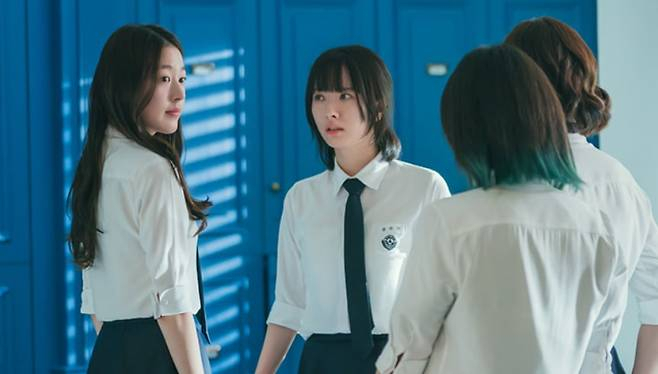

Good versus bad: Pyramid Game is a drama that displays the worst in people: Cowardice, betrayal, violence, hatred, jealousy, envy, despise, etc… but it also shows the best that can come out from such situations such as friendship, camaraderie, solidarity, teamwork, fighting spirit and resilience. Sung Soo Ji and her group embody these newly-found values at Baekyeon High and prove that they will triumph eventually. Good prevails over bad; there’s always light at the end of the tunnel.
Other topics: Pyramid Game revolves around the power dynamics in a mini-society, how to challenge the established order and the friendship that follows. These themes constitute the core of the intrigue. Yet, other topics pop up here and there parallel to the overarching narrative.
Domestic violence: Domestic violence in the drama is tackled through the character of Kim Da Yeon (Hwang Hyun Jung). Though she seems to be yet another bully, she actually has an interesting back story that makes you empathize with her situation. She’s the black sheep of the family, disregarded by her sisters and mothers, and suffering from her father’s domestic violence. Every time she misbehaves, he turns her into his punching ball. This violence and anger rubbed off her. To compensate how miserable and weak she’s at home, she reproduces the same patterns at school against her classmates. When the order is disrupted, Da Yeon loses ground. How come her authority is challenged at school when she’s unable to do the same at home? And if it’s possible to put a full stop to violence, why is it still going on in her house? The patterns she’s been following all her life are shattered by Soo Ji’s success, but that makes her spiral down even more. Her father is even more horrible with her, considering that her behavior is the reason why things are not going his way with Ha Rin’s family company.
Kim Da Yeon’s situation may have been briefly explained, but I believe it was enough to understand where she comes from. Living in a world where she’s constantly assaulted, it makes sense that she would attack and be mean to others to protect herself. Although she didn’t choose the right targets, she’s not matured nor supported enough to go against her parent who basically controls her life, education, finances, and future. She endures in silence, but also learns through pain and betrayal that alliances and friendships are not built in blood but in trust. You will never get the respect of someone you disrespect and hurt in the first place. Da Yeon learns it the hard way. However, the ending may be a new fresh start for her, the opportunity to start on a clean slate.
Homosexuality: Another underlying theme in the drama that is not developed that much is homosexuality. From the get-go, it’s clear that Shim Eun Jeong (Lee Ju Yeon) has feelings for her best friend Im Ye Rim. Although nothing is expressed directly, her behavior implicitly betrays her heart. The way she looks at her, her undeniable support in everything Ye Rim does, her affectionate gestures, and constant presence at her side are enough proof to showcase where Eun Jeong’s heart lies. Even if it’s unclear if Ye Rim also likes her best friend, the ending seems to point at a ‘yes’. I personally appreciated their story and possible romance. It’s not the focus of the drama, but the show tackles it with simplicity and light-heartedness. There’s no judgement, only two teenagers who unveil their fragile feelings for one another.
Father-daughter relationship: Sung Soo Ji and her father have a rather cold relationship. Soo Ji spends most of her time on her own, because of her father’s busy schedule. On top of that, he uproots her every time he has a new mutation and expects her to just start over again and again. This constant state of solitude forged Soo Ji’s character. She became independent, resilient, strong and developed the capacity to solve her problems on her own. That’s why, she never involves her father in her justified vendetta. It is only at the end that the latter discovers everything his daughter has been through. He finally realizes that he failed her as a parent. His absence forced her to grow mature too fast. The end of the drama shows a reconciliation between father and daughter. Soo Ji has recovered her place as a child who needs to be protected by her parent; while her father is finally starting to pay attention to his kid. Their bond may be peculiar, but it is clear that they love each other. They’re not good at expressing it, but the simple fact that they know they have the other’s support says it all.
OST: Ava Grace’s Higher has become my new drug! Not going to lie, the soundtrack perfectly matches the strength and power of the drama. It played at crucial moments of the story, embarking me right away. Just for the OST, I recommend you take a look at this amazing K-Drama!
 Once Upon a Drama