Presentation

Korean Title: 마녀
Aired in: 2025 (10 episodes)
Channel: Channel A, Viki
Grade: 7/10
Actors: Park Jin Young & Roh Jeong Eui
For more…



Park Jin Young:
– He’s Psychometric
– The Devil Judge
– When My Love Blooms
– Yumi’s Cells 2
Roh Jeong Rui:
– The Great Show
– Our Beloved Summer
– Hierarchy
– Crushology 101
Another K-Drama with a witch:
– The Witch’s Diner
Overview
Synopsis
In high school, Dong Jin had a crush on Mi Jeong. She was called a witch because people around her would end up dead or injured. 10 years later, Dong Jin specialized in statistics. He wants to prove that Mi Jeong’s situation is not because of her. While investigating the past incidents, he discovers the reasons behind her misfortune.
My Opinion (No Spoiler)
The concept of that drama grabbed my attention to be fair. I liked the idea that someone would use logic, statistics and science to debunk superstition. I also thought that the whole drama would demonstrate that the female lead was not subject to an actual curse, but rather the victim of an evil human being. I won’t spoil you, but the narrative they chose clearly differs from this initial thought. It was not a bad thing, but we then lacked reasoning and explanations regarding the root cause of the female lead’s ordeal. On top of that, the plot was very repetitive from episodes 1 to 6. The redundancy slowed the plot down and gave the impression that nothing was truly happening. The drama was also introducing scenes (like with Dong Jin’s mother) and characters who didn’t seem to have any role to play in the story. Thankfully, the last four episodes were more interesting and connected scenes/characters together. Moreover, I appreciated learning more about statistics and data in general. This rational world was also well blended with that of the fairytale, as all ingredients of a child’s tale were there (the curse, the Princess and her Prince, the love story). All in all, the drama was not bad per se. It was a clever narrative but it suffered from its slow pace and redundancy.
Analysis
- The fairytale effect
The Princess
The curse
The Prince
The locations - The world of statistics
The objective
Data mining
The law and its variables
The final variable
The unknown cause - 3 distinct chapters
Chapter 1, episodes 1-6
Chapter 2, episodes 7-8
Chapter 3, episodes 9-10 - Atmosphere
- Acting performance
The fairytale effect: The Witch may be a Korean drama airing on a TV screen, but the plot has all the ingredients of a fairytale you generally read in children’s books. Events, characters and even situations fit into that very specific literary genre, giving the impression that the show is just a giant live action.
The Princess: Let’s start with the most important character of them all: The Princess. In old tales, the female lead is often victim of a curse – either cast by an evil person or by fate itself, like for Snow White cursed by the Evil Queen or Aurora in Sleeping Beauty. That’s exactly the case for Park Mi Jeong (Roh Jeong Eui). Every time she is approached by a guy who likes her, he ends up injured or dead. This repetitive pattern in her relationships caused her to cut herself from the rest of society and avoid human contact of all sorts. To protect others, she’d rather stay isolated and alone – hidden in her rooftop apartment like Rapunzel in her tower. Her only hope of regaining a normal life would be to have the curse lifted by something or someone. However, chances of this happening are very slim if we consider the small amount of social interactions she has. Apart from being cursed, Park Mi Jeong is also seen as a beautiful, clever, attractive and kind student, loved by her peers, especially male ones. Like a Princess in a fairytale, she’s much appreciated by men, doted on by adults and envied by women. We can mention Princess Aurora from Sleeping Beauty who’s adored by all, but hated by Maleficent. Mi Jeong’s beauty is also part of her curse in a way, as that’s the exact reason why men want to connect with her in the first place. They have a crush on her and simply wish to see if the feeling is mutual. Beauty, curse, and isolation are the main characteristics of a Princess in tales and Mi Jeong seems to check all the boxes.

The curse: The curse in the drama is way more complex than what we usually see in fairytales. Though the premise is that men who like Mi Jeong will end up dead or injured, there are a lot of rules and variables that come into play and that we discover later on in the show. That same curse is at the core of Mi Jeong’s suffering. She can’t have a normal life and her fellow schoolmates understand rather quickly that incidents are all linked to her. Rumors spread and Mi Jeong is turned into a witch. She falls prey to people’s fear and superstitious spirit. She’s an easy target to explain the unexplainable. Even if she’s the main heroine of the story (and should thus be good like any fairytale Princess), Park Mi Jeong appears here as the main antagonist. She’s like the witch in Hansel and Gretel who’s responsible for causing death and wreaking havoc lives. Interestingly, the drama displays a Princess victim of a curse, but she’s rapidly demonized due to the consequences of her curse. Park Mi Jeong’s curse makes her a Princess as much as an Evil Queen, a victim as much as a witch.
The Prince: In those circumstances, it’s only natural that we would need a Charming Prince to save the Princess. Lee Dong Jin (Park Jin Young) is introduced as a brilliant man who’s got savior syndrome. This means that he can’t help but feel the urge to save others when he sees them in difficulty. Though it’s a praiseworthy behavior that comes in handy in the drama (he provides a job to a man who’s lost everything because of a statistical program he’s developed), it’s however quite dangerous for him. Indeed, his sacrificial spirit, empathy, magnanimity, love and devotion towards Mi Jeong put him at risk every time he approaches her or even tries to understand the rules her curse follows. Nonetheless, Lee Dong Jin has this one quality that makes a Prince who he is: His courage. He’s not swayed by setbacks, doesn’t fret risks, never strays away from his main objective which is to deliver the Princess. He’s had a crush on Mi Jeong since high school and if putting himself at risk is the only to save her – and his friends – then so be it. He’d rather bet on 1% chance than do nothing at all.

The locations: All locations in the drama can remind us of a typical fairytale place. There are two main ones that come to mind to me. The first one is Mi Jeong’s apartment. It kind of reminded me of Rapunzel’s tower. It’s located at the top of the building and there’s only one entrance – the main door, that is preceded by an iron gate. To enter her flat, you need to climb stairs, ring the bell, wait for her to open the first door, and if you’re in luck, she’ll let you go up to the main door. Mi Jeong’s apartment is a fortress that Dong Jin only enters a few times, disguised as a deliveryman. The second location is seen in the last scenes of the drama. At the end, Park Mi Jeong discovers everything that Dong Jin’s been working on. She learns that her curse follows specific rules and that her neighbor has been studying her all along, testing his theories and trying to find a crack in the matrix. In a final attempt to right things wrong, he disappears without a trace. He only leaves behind some hints to his detective friend, so he can guide Mi Jeong. When she finally realizes where Dong Jin’s been hiding all along, Mi Jeong flies to Hallstatt in Austria. This is a small charming city with a beautiful lake scenery, nature around and little people who know their story. Park Mi Jeong’s main job is to translate fairytales to English, that’s why she’s always dreamed of visiting Hallstatt. If you’re unaware, Hallstatt is the town that is said to have inspired Elsa’s Kingdom in Frozen. It’s also apparently the birth place of the Little Mermaid (but this is just pure speculation). Anyway, Hallstatt is a fairytale location for Disney as much as for the drama. It’s in that fantasy-like, magical town that Lee Dong Jin and Park Mi Jeong break the curse and start anew, just like Elsa when she rightfully takes her place on the throne.

The world of statistics: I’ll admit that statistics have never really been my thing. I’ve never managed to get interested in the subject, probably because numbers tend to lull me to sleep. However, I found it fascinating to see how they made use of that field in the drama. I really loved how they intertwined the concrete reality of numbers with the superstitious, if not fictitious, curse. Lee Dong Jin is at the center of that crossroads between worlds. He navigates with ease, and sometimes pain, the world of the concrete and the world of the unreal in order to find a harmonious ground where Mi Jeong can live a ‘normal’ life. Science versus superstition; evidence versus belief; proofs versus rumors. That’s exactly the opposition displayed in that drama.
The objective: As Lee Dong Jin is a scientist, he relies mainly on proof. He’s also a man who needs to structure, test, and verify his theories before he jumps to conclusions. Hence, the establishment of a statistical law related to Mi Jeong’s curse. If we were to describe his law, it would obviously start with its objective. From the moment he meets Park Mi Jeong in high school, Lee Dong Jin is drawn to her. His savior syndrome pushes him to help her out of her demise. He thus builds his entire career on this simple need. He goes into statistics only to verify whether or not rumors are true; whether she’s a witch or just an unlucky human being. He spends years fine-tuning his skills in the field to put his theory and hypotheses to the test.
Data mining: After defining his main objective, or should I rather say his subject of study, Lee Dong Jin deep dives into the world of data mining. Advised by his most trusted professor, the young man decides to go back to square one, where it all started and to compile all the information he can possibly get on Park Mi Jeong and her life accidents. Plunged into the collection of big data, Dong Jin goes back to his old high school to find out all relevant variables and documents on his schoolmates’ deaths and incidents. He also interviews the victims, gathers testimonies, classifies them and crunches all these numbers into Excel sheets. This allows him to highlight crucial similarities between events, but also to showcase errors and variables that may have been overlooked until then. I really felt like Lee Dong Jin was a detective trying to assemble the puzzle pieces of a mysterious case. It was also very interesting to see how data analysts work with data in general and the lengthy process they have to go through before they can start drawing conclusions. The male lead firmly believes in science and its capacity to prove that Mi Jeong is not a witch, but he’s oftentimes swayed by his own discoveries. Every time he thinks he can explain something using numbers, he realizes that the curse may actually be the right answer. This quest has put his faith in science to the test. It opened a door to the mystical world that he was convinced didn’t exist. If you put that into perspective, you can easily apply this idea to our daily lives as well. We tend to rely on science and concrete proof, but there are also things that are out of our control and can’t be explained. Sickness, death, accidents, or even fateful encounters are all subjected to their own set of rules and laws. However, they can’t be deciphered with science. For those specifically, you just have to rely on blind trust and faith. That’s quite a positive message in my opinion: Work hard to achieve what you wish for, but don’t blame yourself if you can’t influence what’s out of your hands.
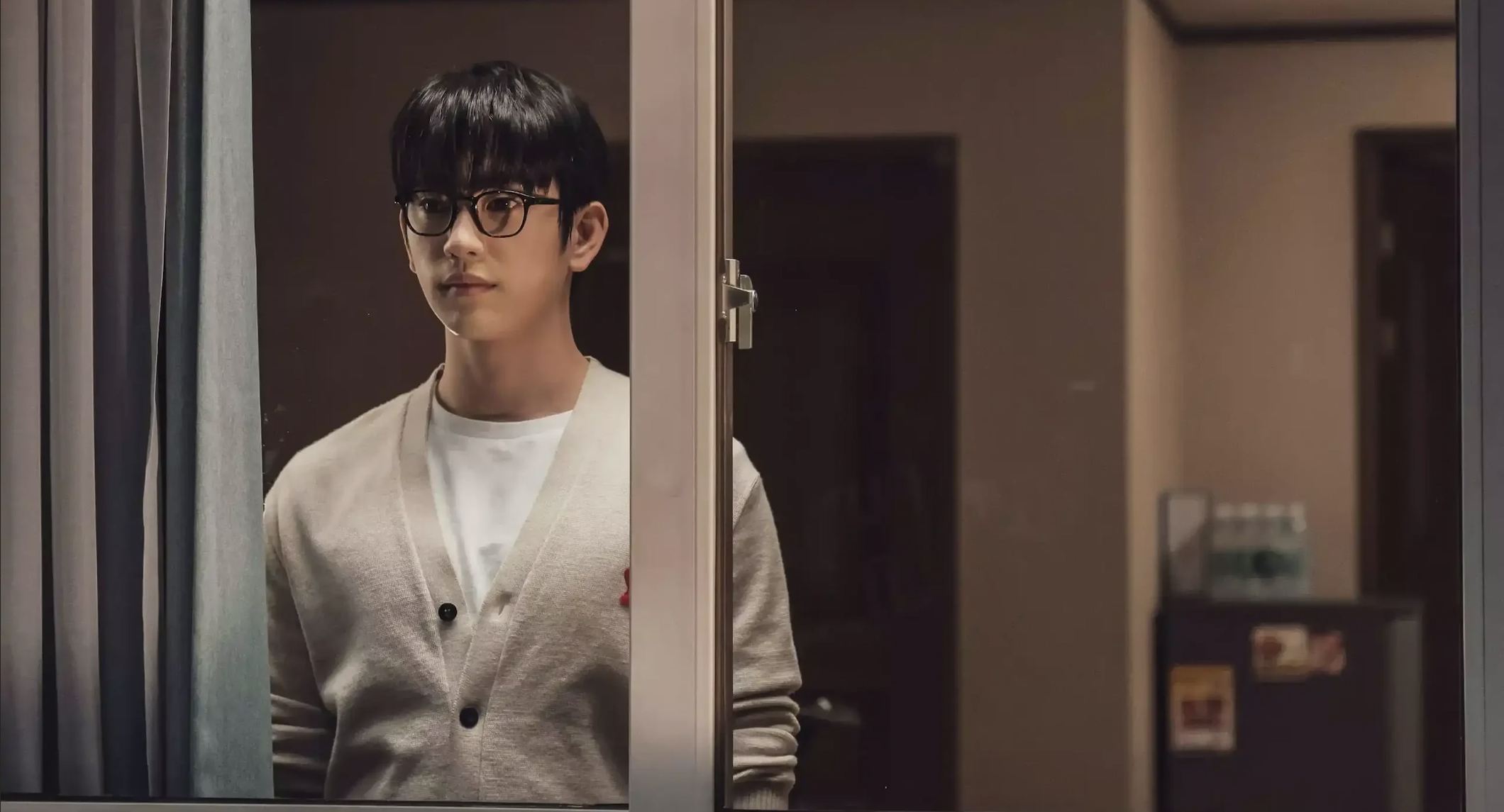
The law and its variables: After a series of tests, Lee Dong Jin manages to come up with a set of rules at the heart of her curse. If you tick the below boxes, you are literally risking your life:
– You are within less than 10 meters from Mi Jeong
– You spend more than 10 minutes with her
– You speak more than 10 sentences to her
– You have a crush on her
– You confess to her
As proven in the show, guys who died after their encounter with Mi Jeong all fit into that law. Those who survived but got injured managed to save themselves because they broke one of these rules. Lee Dong Jin tries them all out with himself to verify his hypotheses. However, this also means that he develops feelings for Mi Jeong along the way. Though he already had a crush on her in high school, the time he spent with her heightened his emotions for her.
The final variable: Throughout the entire show, Lee Dong Jin is desperately trying to find a way to break Mi Jeong’s curse. Though it seems like a vain wish, he comes across a final variable that is set to change the game. Indeed, the statistician realizes that though Park Mi Jeong has no control over external circumstances, her feelings are the one element that save her suitors. When in high school, Mi Jeong had a crush on a boy she’d met at church. At that time, feelings were reciprocated but a sudden incident created a wedge between the two lovers. Mi Jeong thought that her curse had hit again when she saw her crush faint and have a seizure in front of her. He then avoided her, as if he thought she meant trouble. But in reality, it turns out that that man was epileptic and had fled Mi Jeong out of embarrassment and fear that his disease would become known. Upon hearing that, Lee Dong Jin is finally able to add the final puzzle piece to the mystery. Only true love, from the Princess herself, can protect her loved one. At the end of the drama, Dong Jin confesses his feelings and disappears, giving Mi Jeong enough time to think about her feelings as well. After a time, she reunites with him and confesses herself. She’s willing to start anew. Although the ending is a happy one, I kind of felt as if the intrigue was a bit precipitated. Park Mi Jeong and Lee Dong Jin never truly had the time to develop feelings for one another, so it seemed rushed that Mi Jeong suddenly fell head over heels for her man. On top of that, I would add that being in a relationship with Mi Jeong is a risky bet, especially when you know that her love is fragile and one small mistake can take your life. Anyway, Lee Dong Jin bet his life on that, and he succeeded for now.

The unknown cause: I was quite surprised to see that the drama had chosen to adhere to the curse narrative. I was 80% convinced that there would be a rational explanation behind these accidents and deaths (like a person). Therefore, I was expected a more thriller-like drama. Don’t get me wrong though, I was satisfied with that choice. But it came with a set of questions that remained unsolved in the show. The pre-requisite is clear. Park Mi Jeong is a witch and we clearly see the consequences of her condition. However, we have absolutely no insights as to why she is a witch, and not one of her classmates, or even why Lee Dong Jin’s friend is a witch as well. How does it work? How are you selected by fate to become a witch? Are there specific characteristics between witches, apart from the fact that they are isolated from society? Are there others except these two? How come they can’t control anything? Or maybe they can learn to control that using their feelings? So many interrogations that left me wanting to know more. It felt like a huge piece of the puzzle was missing, leaving the narrative with an incomplete hole.
3 distinct chapters: The drama is clearly split into 3 different parts for me. The pace varies from one part to another and the focus of the intrigue is more or less lost.
Chapter 1, episodes 1-6: To me, what I will call Chapter 1 was the least interesting part of the drama. It was redundant and boring, always showing and showing us the same information. At that time in the plot, there are a lot of flashbacks in which Lee Dong Jin starts working into statistics, while Mi Jeong slowly cuts herself from the rest of the world. Parallel to that, the male lead goes back to high school to investigate the past and consolidate data on accidents. We’re seeing the same scenes over and over again. The few times the plot isn’t redundant, characters – like Dong Jin’s mother, his friend Kim Joong Hyuk (Im Jae Hyuk) or Mi Jeong’s friend Heo Eun Sil (Jang Hee Ryung), – are introduced. But it’s difficult to understand why they are even present at all. There’s no link to the actual story, so we just wonder what’s their use. Thankfully, their role is explained, but only at the end of the drama.
Chapter 2, episodes 7-8: Chapter 2 accelerates the pace and displays some new elements, as Lee Dong Jin is testing his law and its variables. This part is anchored in the present and showcases advancements not only in Dong Jin’s theory, but also in his relationship with Park Mi Jeong.
Chapter 3, episodes 9-10: The last part is by far the most interesting. Although we get the grand finale between Dong Jin and Mi Jeong with their reunion in Austria, that’s not the part that grabbed my attention the most. Indeed, this part is essential to understand that Mi Jeong is not an isolated case. Other witches exist, among which Kim Jung Hyuk (Dong Jin’s friend). From then on, his entire introduction to the story and the scenes we’ve witnessed start to make sense. Lee Dong Jin had at heart to help his lover, but also his friend who seems trapped by his curse. To be honest, Kim Jung Hyuk and Heo Eun Sil’s blooming love story was my favorite part. It was quite realistic, as Jung Hyuk preferred to stay away from Eun Sil, as long as he had no feelings for her. This twist was powerful, I would’ve loved to see more of them. Two episodes were not enough, especially when you consider that their dynamics is reversed versus the main couple. In the end, statistics and fairytale blended in the final moments of the show. The scientific law allowed Mi Jeong to understand that her feelings had an impact on her lover’s fate, and that her love could lead her to a happily ever after.
Atmosphere: Funnily enough, The Witch reminded me of two other series/movies that I’ve watched. For everything related to deaths and incidents, I couldn’t help but think about Final Destination, the American movies, in which death hits all of those who managed to escape it in the first place. The way men around Mi Jeong would die was just so surreal (thunder to name one). Hence the uncanny resemblance with the US movies – that I recommend by the way. As for the second show, I kind of have to quote the US series You. At some point, Lee Dong Jin’s behavior appeared quite creepy to me. If you put it in perspective, he spent years studying and spying on Mi Jeong in the shadows, he stalked her and lied to her several times. Though his intentions were good, it would’ve been easy to misunderstand if the show had not explained the reason he was doing that in the first place. Considering that I mentioned stalking and death, you can quite guess the kind of ambiance the show has. Add a little touch of fantasy and optimism and you have it.
Acting performance: Though the drama was not a favorite for me, and many parts bothered me – the redundancy of the episodes for instance – I still need to salute the acting performance. I believe Park Jin Young was exceptionally good. He was credible and portrayed very well the raw emotions of his character. Roh Jeong Eui was also really good, but Jin Young shone the most in my opinion.
 Once Upon a Drama