Presentation

Korean Title: 이 사랑 통역 되나요?
Aired in: 2026 (12 episodes)
Channel: Netflix
Grade: 9.5/10
Actors: Kim Seon Ho & Go Youn Jung
For more…



Kim Seon Ho:
– Welcome to Waikiki
– Start Up
– Hometown Cha Cha Cha
– When Life Gives You Tangerines
Go Youn Jung:
– Law School
– Alchemy of Souls Season 2
– Moving
– Resident Playbook
K-Dramas by the Hong sisters:
– The Greatest Love
– The Master’s Sun
– Hotel del Luna
– Alchemy of Souls
Overview
Synopsis
Joo Ho Jin is a very skilled multilingual interpreter who’s fluent in English, Japanese and Italian. He starts working for top star Cha Mu Hee as her interpreter. She has bright charms and is always confident. They start developing feelings for each other.
My Opinion (No Spoiler)
There couldn’t have been more accurate title to fit that drama. The whole plot revolves around language, and going beyond words to understand each other. I loved how ordinary words (like ‘Thank you‘, ‘Sorry‘, ‘Goodbye‘ or ‘I love you‘) have a deep meaning in the show and create links between characters. Every detail counts, from what characters say to small items (clovers) and bigger ones (auroras and the stars). The drama tackles mental health very well by deep diving into Cha Mu Hee’s psyche and traumas. You can clearly see how one event can influence the rest of your life, even if it is latent. Self love, letting go, being happy, accepting one’s past and moving on are all themes that are mentioned in the drama and deeply embedded in the narrative. The relationship between Ho Jin and Mu Hee is so great, I also loved Hiro to be fair and even the secondary characters, like Yong Woo and Ji Sun, were quite compelling. The aesthetics of the show, especially the landscapes in Canada, Italy, South Korea were absolutely stunning and Go Youn Jung’s acting performance as Do Ra Mi was incredible. Finally, I particularly enjoyed the opening and ending scenes. Don’t want to spoil it for you, but I think these were extremely clever and really sum up the spirit of the show. Highly recommended!
Analysis
- Words at the core of everything
Can this love be translated?
Words have weight - Romances
Ho Jin’s haunting past
Mu Hee and her ex
Symbols of love
Clean breakups
Starting over - Mental health and traumas
Dissociative Identity Disorder
Self-love - The perfect writing
The opening scene
The ending scene
Lesson to take away - Cinematography and aesthetics
Words at the core of everything: Joo Ho Jin (Kim Seon Ho) is a polyglot, fluent in Korean, Japanese, Italian and English, who became an interpreter. His linguistic abilities are not only useful for his career, but also in his love life after his encounter with Cha Mu Hee (Go Young Jung). Language barriers, meaningful words, literary contents (books, poems, etc…) are at the center of the plot and the romance.
Can this love be translated? Despite his fluency in 4 languages, Joo Ho Jin struggles to understand Cha Mu Hee. Though they both speak Korean, it seems like they’re unable to communicate properly. Every conversation leads to a misunderstanding, wedging a wall between characters. In that matter, the title of the drama makes so much sense. Asking whether this love can be translated is a legitimate question that takes 12 episodes to answer. Throughout the drama, Joo Ho Jin slowly learns a new language. He expands his vocabulary by witnessing Mu Hee’s different personalities (as Do Ra Mi and herself). He feels the profound meaning of words by getting to know her insecurities, her past and traumas. He messes up the syntax or grammar in his sentences by mistaking her feelings. But he also masters this new challenge after hours of study. As a good interpreter, he becomes fluent in Mu Hee’s language which is concomitant with the start of their relationship.
Words have weight: What I love the most about the show is how ordinary words have actual weight and meaning. ‘Thank you‘ or ‘I’m sorry‘ are basic words in all languages that are commonly used in our every day lives. Yet, these are also the main vectors of emotions between characters. For example, Cha Mu Hee is constantly either thanking or apologizing to Hiro (Sota Fukushi). Though they are harmless in her eyes, these words are burdensome for the Japanese actor. They mislead him into thinking that Cha Mu Hee is interested in him, but also work as a rejection and make him feel as if Cha Mu Hee is always indebted to him. Joo Ho Jin and his mother can also be mentioned in that matter. They were estranged and unable to reconnect. Yet, these two basic words allowed them to reconcile. His mother apologized for not being present, while Ho Jin says sorry for acting cold towards her. Other ordinary words in the show carry the same weight like ‘Goodbye‘ (between Ho Jin and Ji Sun), ‘I love you‘ (Ho Jin and Mu Hee) or even the word ‘breakup‘ which is used by Mu Hee to communicate her inner feelings. Her insecurities make her push people away and generally precipitate the breakup with her partner. So, Ho Jin uses that same word against her to make her stay. What’s the point in trying to destroy the relationship if they know they will breakup in the end? While they wait for that moment to come, they can just enjoy the present. That’s a good Uno-reverse on Ho Jin’s side!
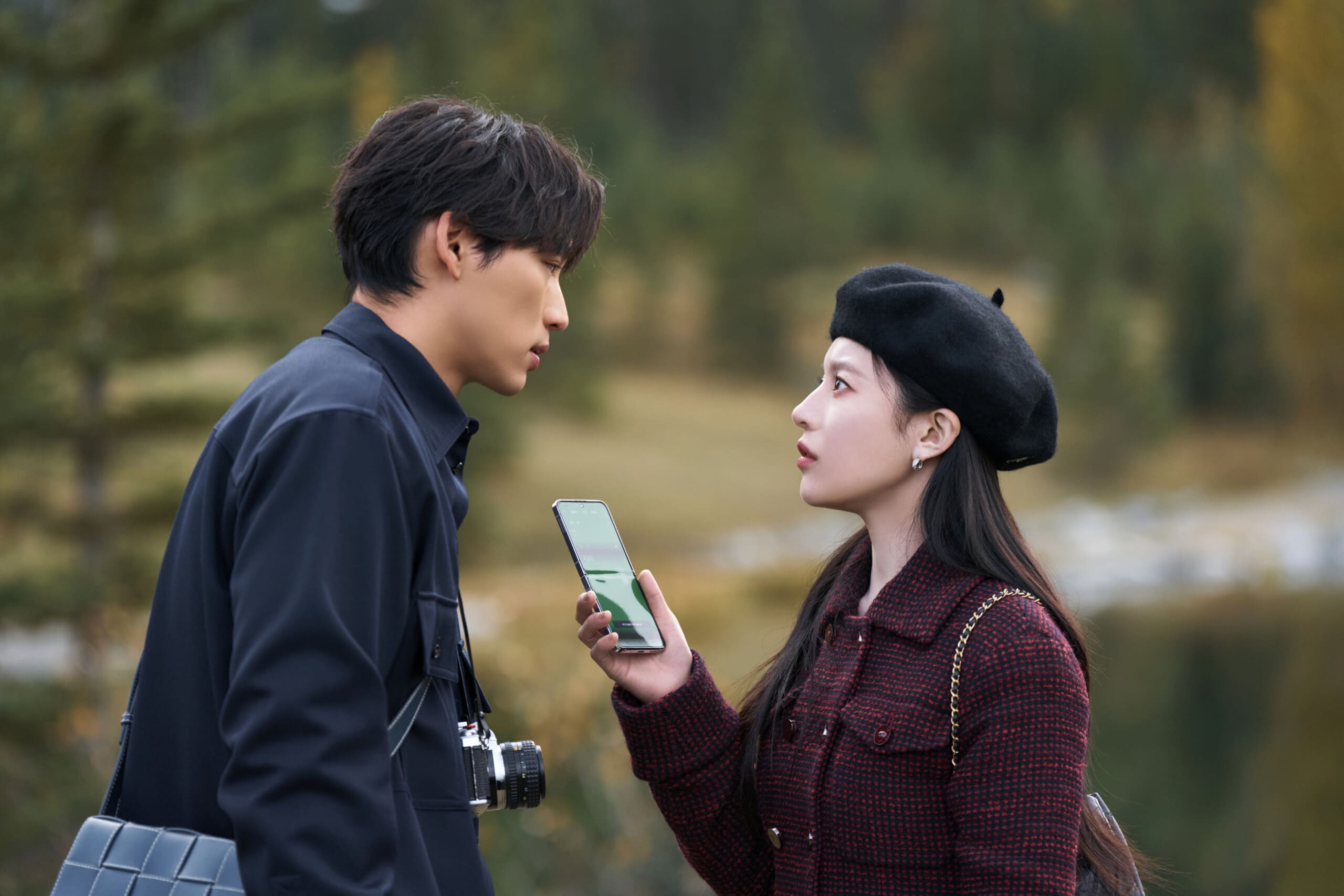
Romances: There are several romances in the drama that take their time to develop because each character has to overcome his/her fair share of problems first.
Ho Jin’s haunting past: Joo Ho Jin has been in love with his brother’s girlfriend Shin Ji Sun (Lee Yi Dam) for years. At the beginning of the drama, Ho Jin is trying hard to forget her, but can’t get a hold of his feelings. To him, this love is like a ‘horror movie‘ because he’s unable to let go. He feels trapped and incapable of moving on, even when Cha Mu Hee starts pursuing him. Yet, the actress is so determined to get him that he eventually realizes she’s the person he wants to be with and not Ji Sun. That’s why Ho Jin manages to tell the truth to his past crush at the end, thus cutting ties with his old feelings for good.

Mu Hee and her ex: If there’s but one thing we can thank Mu Hee’s ex for is that he led to her encounter with Ho Jin in Japan. At the beginning of the show, Mu Hee is an unknown actress who’s come to Japan to find her ex. He’s cheated on her with his brother’s wife and got her pregnant. Though he’s not present in the first scenes, his new girlfriend is and talks ill about his former girlfriend. Later on, he makes a comeback in Mu Hee’s life when she’s at the heart of a cheating scandal. He then reveals that she’s always been too anxious and clingy in the relationship. He felt as if they were about to breakup anytime and couldn’t stand this attitude anymore. That’s why he left her.

Symbols of love: When Ho Jin and Mu Hee meet in Japan for the first time, neither is ready for a relationship. However, they form a connection that will blossom afterwards and turn into real love. The drama is punctuated by symbols representative of their romance like the four-leaf clovers Cha Mu Hee searches for and the lucky 7 aka the seven four-leaf clovers she manages to find, hoping it would help her wish come true. But you also have the auroras and the Milky Way that connect characters despite the distance. And obviously the famous ‘babe‘ (‘chaggi’) that Do Ra Mi uses whenever she speaks to Ho Jin. This word is also of great help when the male lead tries to guess whether he’s talking to Do Ra Mi or Cha Mu Hee.
Clean breakups: Romances are great in the show, but breakups are also super clean. Years after withholding the truth, Joo Ho Jin finally reveals to Ji Sun that he used to like her. They have an in-depth conversation on their way to Busan that serves as a final goodbye. Both are ready to start new adventures and relationships. This scene was a necessary closure for Hoo Jin who can unburden himself and finally be free. Cha Mu Hee also says goodbye to Hiro at the end, after realizing his feelings for her were genuine. He’s the fantasy Prince who helped Mu Hee/Ra Mi when they needed support and she will never thank him enough for that.
Starting over: I loved the secondary romance between Shin Ji Sun and Kim Yong Woo (Choi Woo Sung). They get attracted to each other on the set of the variety show, then get together shortly after Ji Sun has broken up with her fiancé. They were supposed to get married, but Ji Sun realized that he was too free-spirited for her. Though she and Yong Woo misunderstand each other at some point, they find their way back to one another. Nevertheless, Yong Woo has been given the opportunity to go abroad and fears this would lead to a breakup. But stars align for the pair, as Ji Sun was also thinking about leaving South Korea. Their romance is proof that love works in mysterious ways and can just arrive in your life unexpectedly, yet lead to amazing outcomes.


Mental health and traumas: Through Cha Mu Hee’s character, the drama explores mental health, traumas and their impact on someone’s life.
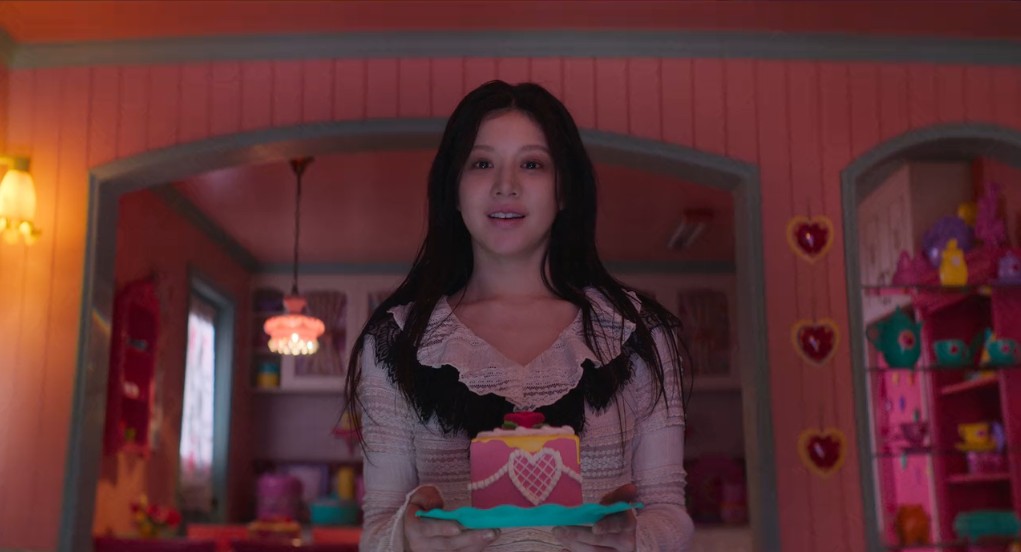
Dissociative Identity Disorder: Cha Mu Hee is an actress who rises to fame whilst in the coma. She gets into an accident on set and spends months in the hospital. When she wakes up, she discovers that the character she played on screen, Do Ra Mi, has broken all records and propelled her to the top. Cha Mu Hee now tries to cope with her newly found celebrity, but she gradually starts seeing Do Ra Mi. At first, she believes that her hallucinations are caused by stress and media pressure. However, her symptoms grow stronger to the point that Do Ra Mi starts taking over. Cha Mu Hee suffers from DID (Dissociative Identity Disorder), meaning that she has developed another personality. Do Ra Mi is the manifestation of Cha Mu Hee’s anxiety. When Mu Hee can’t handle her emotions, Do Ra Mi, her bolder and more audacious side, resurfaces to protect her. Turns out, Cha Mu Hee’s trauma has always been latent, but only recently manifested through Do Ra Mi.
Self-love: Cha Mu Hee’s personality disorder can be explained by the trauma she suffered as a child. When she was 7, her mother tried to kill her husband and daughter by poisoning them. The young kid saw her father die (almost) and heard her mother say that no one would ever love her and she’ll never be happy now that her parents are gone. Mu Hee then jumped out of the window to escape. When the kid woke up from the shock, she pretended she’d lost her memory and buried that moment deep in her subconscious. However, this event kept haunting her until it resurfaced through Do Ra Mi. To add to the trauma, Cha Mu Hee is the spitting image of her mother. But she couldn’t remember it. That’s why she believed that it was Do Ra Mi all along, when in reality she was seeing the memory of her mother. In a nutshell, Cha Mu Hee’s disorder stems from low self-love and self-worth, the fear of being abandoned/rejected, a traumatic and tragic memory, and great anxiety at the simple idea that her happiness could stop anytime. These insecurities dictated her relationship with her ex, but also with Ho Jin. She’d always try to sabotage everything to prove herself right and demonstrate she’s not worthy of love. After discovering all that, Joo Ho Jin emphasizes his love to Cha Mu Hee. He also uses reverse psychology to lessen her anxiety, while reassuring her. He’s definitely her best treatment.
The perfect writing: The Hong Sisters are definitely genius screenwriters who delivered both a perfect opening and ending.
The opening scene: In less than 10 minutes, the opening scene introduces the entire show. Hiro and Cha Mu Hee are filming in an Italian castle. The Japanese actor confesses his feelings in his language, while Ho Jin translates. But the latter struggles to deliver these words to Mu Hee. To me, this scene can be interpreted differently based on where you are in the drama. At the beginning, this seems like a basic the love triangle. Hiro has fallen for Mu Hee, so has Ho Jin. Hence his reluctance to translate the confession. However, that scene can be seen under another prism after you’ve seen a few episodes. Mid-drama, it’s played again. Hiro and Mu Hee are filming the final episode of their travel variety show. Cha Mu Hee has no feelings whatsoever for Hiro and the latter doesn’t even seem convinced either. In that precise moment, it feels as if Hiro is using his own confession as a way to force Ho Jin’s. The interpreter has fallen for Cha Mu Hee, but struggles to sort his feelings out. By saying ‘I love you‘ to Mu Hee, Hiro helps Ho Jin say it to her as well.
The ending scene: The ending combined all of the elements representing the couple. First of all, you have the reference to Papago which is Ho Jin’s name in Mu Hee’s phone. Second, Mu Hee uses a translation app to talk to Ho Jin in the 4 languages he knows. She also talks about the clovers and the stars. Auroras held a deep meaning between them in Canada. They have then promised they’d go see the stars and the Milky Way together. That’s why they are in a building made for it. You even have the Italian opera music of the movie Pretty Woman they mention in the drama at some point. Ho Jin argues that this is a sad opera song which shocks Mu Hee. When that music starts to play at the end, it then shifts to a happier one. There was no better happy ending possible.
Lesson to take away: I believe there’s one main lesson to take away from the drama that is embodied by Hiro. He says it himself: ‘If I don’t fight for something I really want, I will be left with nothing but regret‘. This follows his time in Italy with Cha Mu Hee when he hesitated to confess his feelings. He missed the right timing and lost the girl. Since then, he’s grown more mature and is fueled by a new fire to try things out, follow his heart and go for it.
Cinematography and aesthetics: I don’t think I need to say too much about the cinematography or the aesthetics of the drama because the show speaks for itself. Landscapes in Canada, Italy and South Korea were simply amazing, the cuts were perfect, the lights, everything deserves praise.
 Once Upon a Drama